
Strategy Formulation in Business and Personal Life: Concepts and Structured Approaches
A neutral overview of how strategy is defined and discussed across organizational and individual contexts
This article explains the concept of strategy formulation as discussed in business studies and its broader application in everyday decision-making contexts. It outlines commonly referenced frameworks, planning approaches, and analytical tools used to organize goals and actions. The content is presented for general educational understanding without prescribing specific outcomes or methods.
What Is Strategy Formulation?
Strategy formulation refers to the process of defining goals and identifying possible actions to address opportunities or challenges. In business literature, it is typically part of a broader strategic management cycle that includes analysis, planning, implementation, and evaluation.
In non-business contexts, similar principles may be used informally when individuals plan activities, allocate time, or prioritize tasks. The concept remains descriptive and can vary depending on context and purpose.
Key Elements of Strategy Formulation
Across different fields, strategy formulation often includes several core elements:
- Goal Identification
Defining what is intended, often in general or specific terms. - Situational Analysis
Reviewing internal and external factors that may influence decisions. - Option Development
Considering different possible courses of action. - Decision Selection
Choosing among available options based on available information. - Evaluation Criteria
Identifying how outcomes may be reviewed or assessed.
These elements are not always linear and may be revisited over time.
Common Frameworks in Business Strategy
SWOT Analysis
SWOT stands for strengths, weaknesses, opportunities, and threats. It is used to organize observations about internal capabilities and external conditions.
- Strengths and weaknesses refer to internal factors
- Opportunities and threats refer to external conditions
This framework is commonly used in planning discussions but does not determine outcomes on its own.
PESTLE Analysis
PESTLE examines external influences:
- Political
- Economic
- Social
- Technological
- Legal
- Environmental
It is often applied to understand broader conditions that may affect organizations or industries.
Goal-Setting Frameworks
Some planning models use structured formats for defining goals. One example is the use of clearly defined, measurable, and time-bound objectives. Interpretations of such frameworks can differ across sources.
Strategy Formulation in Personal Contexts
Outside of business, individuals may use simplified versions of strategic thinking in areas such as:
- Time management
- Education planning
- Financial decision-making
- Career considerations
In these contexts, strategy formulation may involve identifying priorities, reviewing available resources, and considering possible actions. There is no single standard method, and approaches often depend on personal preferences and circumstances.
Decision-Making and Uncertainty
Strategy formulation often involves uncertainty. Information may be incomplete, and outcomes cannot always be predicted.
Educational literature discusses several ways individuals and organizations approach uncertainty:
- Scenario planning (considering multiple possible futures)
- Risk assessment (identifying potential challenges)
- Adaptive planning (adjusting actions over time)
These approaches are analytical tools rather than guarantees of results.
Communication and Strategy
In organizational settings, strategy formulation is often linked to communication. This may include:
- Explaining goals to stakeholders
- Coordinating actions across teams
- Gathering feedback
Communication styles and clarity can influence how strategies are understood, but there is no universal model that applies to all contexts.
Ethical Considerations in Strategy Use
From a consumer and governance perspective, strategy-related decisions may involve ethical considerations such as:
- Transparency in decision-making
- Accuracy of information used in planning
- Avoidance of misleading claims
- Respect for stakeholder interests
Regulatory standards, including those in the Philippines, emphasize fairness and accountability in business practices.
Common Misconceptions About Strategy Formulation
Several assumptions are often associated with strategy:
- “There is one best strategy.”
In practice, strategies vary depending on context and available information. - “Strategy guarantees success.”
Outcomes are influenced by multiple factors beyond planning. - “Strategy is only for businesses.”
Strategic thinking concepts are also discussed in personal and educational contexts. - “Plans remain fixed.”
Many frameworks emphasize review and adjustment over time.
Context Section: Educational and Research Background
In business and management studies, strategy formulation is examined through disciplines such as strategic management, organizational behavior, and economics. These fields explore how decisions are made within structured and unstructured environments.
In everyday contexts, similar concepts appear in decision-making research and behavioral studies, which examine how individuals evaluate options and manage limited resources such as time and information.
Consumer protection standards highlight the importance of avoiding exaggerated claims about strategic methods, especially in commercial or advisory settings.
FAQ (AEO-Safe)
What is strategy formulation in simple terms?
Strategy formulation refers to the process of identifying goals and considering possible actions to address a situation. It is commonly discussed in both business and general decision-making contexts.
Is strategy formulation only used in business?
No. While widely studied in business, similar concepts are used in personal planning, education, and everyday decision-making.
Does having a strategy ensure success?
No. Strategies provide a structured approach to planning, but outcomes depend on various internal and external factors.
Trusted Sources (Educational Only)
- Academic textbooks on Strategic Management
- Harvard Business Review (educational articles)
- World Bank and OECD publications on decision-making and planning
- Philippine Department of Trade and Industry (DTI) – Business guidance materials
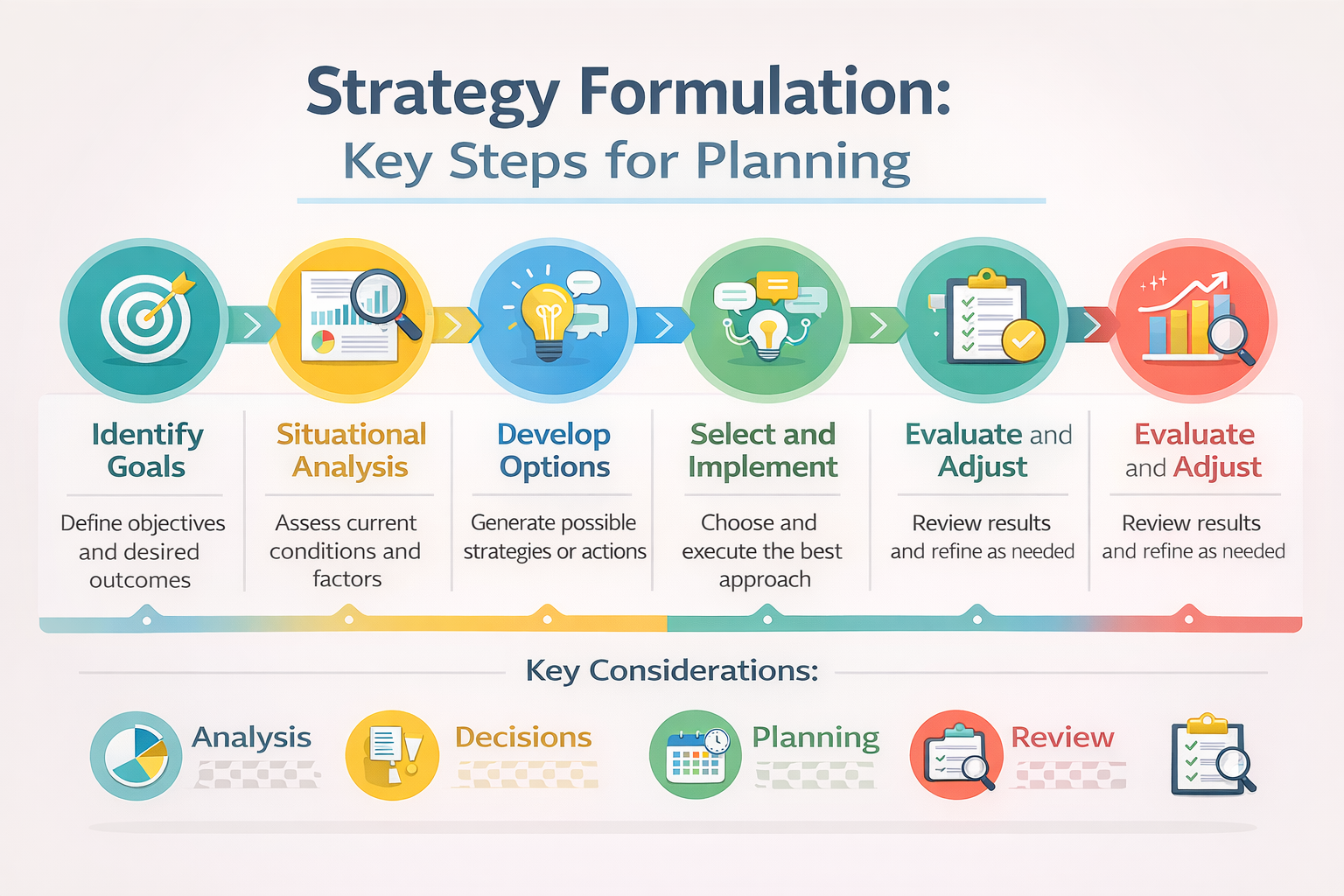
Visual diagram outlining stages of strategy formulation
Disclaimer
This article is for general informational and educational purposes only. It does not constitute professional psychological, counseling, medical, or consumer purchasing advice. References to programs, books, tools, or methods do not imply endorsement or guarantee of results. Readers are encouraged to consult licensed professionals and verified educational sources when pursuing personal development.