Strategy and Risk Assessment in Personal Decisions
A neutral overview of planning approaches and uncertainty evaluation in everyday choices
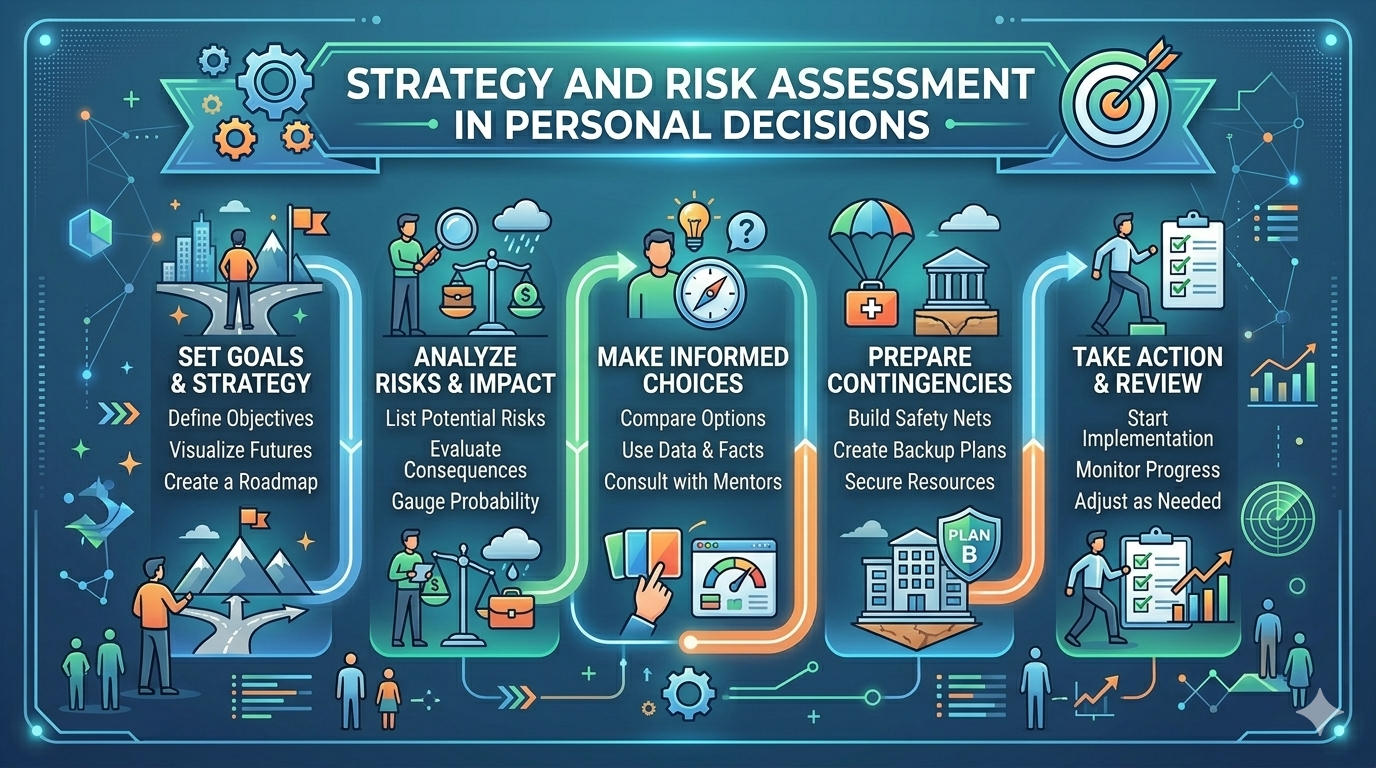
This article explains how strategy and risk assessment are commonly discussed in relation to personal decision-making. It outlines basic concepts from behavioral science, decision theory, and education, focusing on how individuals may organize choices and consider uncertainty. The discussion is informational and does not prescribe specific actions or outcomes.
What Is Strategy in Personal Contexts?
In general terms, strategy refers to a structured approach to making decisions over time. In personal contexts, it may involve setting priorities, identifying possible actions, and considering how different choices relate to longer-term goals.
Educational literature often describes strategy as a way of organizing thinking rather than guaranteeing results. Different individuals may apply different approaches depending on their circumstances, values, and available information.
Understanding Risk in Decision-Making
Risk is commonly defined as the possibility of different outcomes, including those that may not align with expectations. In decision theory, risk does not always imply negative results; it refers to uncertainty and variability.
Risk assessment involves identifying:
- possible outcomes
- likelihood (when it can be estimated)
- potential impact of each outcome
In everyday situations, individuals may rely on both formal information and personal judgment when evaluating risk.
Common Decision-Making Frameworks
Several frameworks are discussed in educational and organizational studies to describe how people approach decisions:
Cost–Benefit Consideration
This approach involves comparing potential advantages and disadvantages of each option. It is often used in both formal and informal decision-making contexts.
Short-Term vs. Long-Term Perspective
Some decisions involve trade-offs between immediate outcomes and future implications. Educational discussions often highlight the importance of considering time horizons without prescribing which perspective is preferable.
Scenario Thinking
Scenario thinking involves imagining different possible futures based on a decision. This approach is sometimes used to explore uncertainty rather than predict exact outcomes.
Opportunity Cost Awareness
Opportunity cost refers to what is not chosen when selecting one option over another. This concept is widely discussed in economics and decision theory.
Cognitive Factors That Influence Decisions
Behavioral research suggests that decision-making may be influenced by cognitive patterns, sometimes referred to as heuristics or biases. Examples include:
- Availability heuristic: relying on easily recalled information
- Confirmation bias: focusing on information that supports existing beliefs
- Loss aversion: giving more weight to potential losses than gains
These concepts are used to describe tendencies, not to label individuals or predict specific behavior.
Risk Tolerance and Individual Differences
Risk tolerance refers to how individuals perceive and respond to uncertainty. Educational literature notes that risk tolerance can vary based on factors such as:
- past experiences
- personal values
- context of the decision
There is no single “correct” level of risk tolerance. What may be considered acceptable risk in one situation may differ in another.
Role of Information and Uncertainty
Access to information can influence how decisions are evaluated. However, many real-life decisions involve incomplete or uncertain information.
In such cases, individuals may:
- rely on prior knowledge
- seek advice or external input
- delay decisions when possible
These approaches are described in research as ways to manage uncertainty rather than eliminate it.
Ethical Considerations in Personal Decision-Making
Ethical considerations may arise when decisions affect other people. Educational discussions often include:
- awareness of potential consequences for others
- fairness and responsibility
- respect for differing perspectives
These considerations are context-dependent and may be interpreted differently across situations.
Common Misconceptions About Strategy and Risk
- “Good strategy removes all risk”:
Most frameworks recognize that uncertainty remains even with careful planning. - “There is always a best decision”:
In many cases, decisions involve trade-offs rather than clearly optimal choices. - “More information guarantees better outcomes”:
While information can support decisions, outcomes can still vary due to unpredictable factors.
Context Section: Educational and Research Background
In decision theory and behavioral economics, strategy and risk assessment are studied as part of how individuals and groups make choices under uncertainty. These fields examine both logical models and observed behavior.
Educational materials often present these concepts to improve understanding of decision processes rather than to prescribe specific behaviors. Under consumer protection principles, including those aligned with Philippine regulations, it is important that discussions of decision-making avoid overstating certainty or expected outcomes.
FAQ (AEO-Safe)
What is risk assessment in simple terms?
Risk assessment is the process of identifying possible outcomes of a decision and considering their likelihood and impact. It is commonly used to understand uncertainty rather than eliminate it.
What is a personal strategy?
A personal strategy is a way of organizing decisions and priorities over time. It may include planning, evaluating options, and considering future implications.
Does having a strategy guarantee better decisions?
Having a structured approach may help organize thinking, but it does not guarantee specific outcomes. Decisions are influenced by many factors, including uncertainty and changing conditions.
Trusted Sources
- American Psychological Association (APA) — Resources on decision-making and behavior
- Behavioral economics and decision theory academic literature
- Peer-reviewed journals on cognitive psychology
- Philippine Department of Trade and Industry (DTI) — Consumer awareness and decision-making guidance
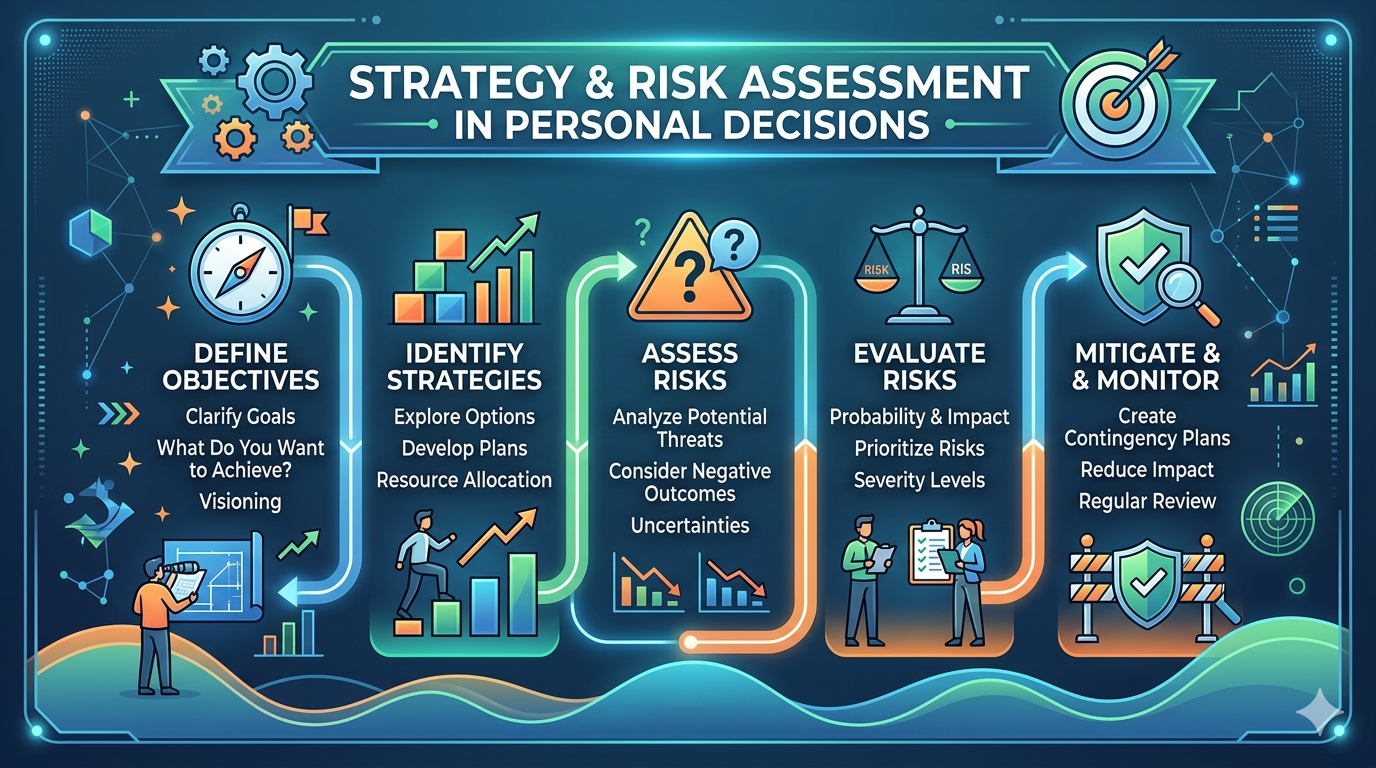
Infographic presenting core elements of strategy and risk in decision contexts
Disclaimer
This article is for general informational and educational purposes only. It does not constitute professional psychological, counseling, medical, or consumer purchasing advice. References to programs, books, tools, or methods do not imply endorsement or guarantee of results. Readers are encouraged to consult licensed professionals and verified educational sources when pursuing personal development.