
Strategic Thinking Skills for Modern Leaders
A Neutral Overview of Analytical and Decision-Making Concepts in Leadership Contexts
Strategic thinking is a topic commonly discussed in leadership, management, and organizational studies. This article provides an educational overview of strategic thinking skills, including how they are defined, the components often associated with them, and how they are described in academic and professional literature. The focus is on explanation rather than instruction or outcome-based claims.
What Is Strategic Thinking?
Strategic thinking generally refers to the ability to analyze situations, consider long-term implications, and evaluate possible courses of action. It is often discussed in contrast to short-term or purely reactive decision-making.
In leadership studies, strategic thinking is not considered a single skill but a combination of cognitive processes that may include analysis, planning, and interpretation of complex information.
Core Elements of Strategic Thinking
Educational and organizational literature often identifies several components associated with strategic thinking:
Systems Perspective
This involves viewing situations as part of a broader system. Leaders may consider how different variables—such as people, resources, and external factors—interact with each other.
Long-Term Orientation
Strategic thinking often includes attention to future implications. This may involve anticipating possible scenarios rather than focusing only on immediate outcomes.
Analytical Reasoning
Analytical reasoning refers to examining information, identifying patterns, and evaluating alternatives. It is commonly discussed in decision-making frameworks.
Adaptability to Change
In dynamic environments, adaptability is often referenced as a related concept. This includes adjusting interpretations or plans when new information becomes available.
Decision-Making in Leadership Contexts
Strategic thinking is frequently linked to decision-making processes. In leadership research, decision-making may involve:
- identifying available information
- weighing potential risks and trade-offs
- considering multiple perspectives
There is no single model that applies in all situations. Different organizations and fields may use varying approaches depending on context.
Communication and Strategic Alignment
Communication is often described as a supporting factor in strategic thinking. Leaders may need to convey ideas, plans, or interpretations clearly to others within a group or organization.
In educational discussions, alignment refers to how individual or team actions relate to broader goals or objectives. Communication plays a role in maintaining shared understanding.
Strategic Thinking and Organizational Context
Strategic thinking is typically influenced by the environment in which it occurs. Factors may include:
- organizational structure
- available resources
- cultural and social context
- external conditions such as market or policy changes
Because of these variables, strategic approaches may differ across industries and regions.
Ethical Considerations in Strategic Leadership
Leadership and strategy discussions often include ethical considerations. These may involve:
- transparency in decision-making
- accountability for outcomes
- responsible use of information
In both public and private sectors, ethical standards are shaped by regulations, institutional policies, and broader societal expectations.
Common Misconceptions About Strategic Thinking
Several misconceptions appear in general discussions:
- Misconception: Strategic thinking guarantees success
Research does not support guaranteed outcomes. Results may vary depending on multiple internal and external factors. - Misconception: Only senior leaders need strategic thinking
Educational literature often describes strategic thinking as relevant across different roles, although its application may differ. - Misconception: Strategy is only about long-term planning
While long-term orientation is a component, strategy also involves ongoing analysis and adaptation.
Context: Educational and Research Background
In management and leadership studies, strategic thinking is often examined as part of organizational behavior and decision science.
In academic contexts, it is discussed alongside topics such as critical thinking, problem-solving, and systems analysis.
Under consumer and professional standards, particularly in leadership training materials, it is important that claims about strategic effectiveness remain evidence-aligned and free from exaggeration.
Frequently Asked Questions (FAQ)
What is strategic thinking in simple terms?
Strategic thinking refers to analyzing situations, considering long-term implications, and evaluating different possible actions. It is commonly discussed in leadership and organizational contexts.
Is strategic thinking the same as planning?
Planning is often considered one part of strategic thinking. Strategic thinking may also include analysis, interpretation, and adaptation.
Can strategic thinking vary by context?
Yes. Strategic thinking approaches may differ depending on organizational, cultural, and situational factors.
Trusted Sources
- Organizational behavior and leadership textbooks
- Peer-reviewed journals in management and decision sciences
- Academic publications on systems thinking and strategic management
- Professional standards and guidance from regulatory and educational institutions
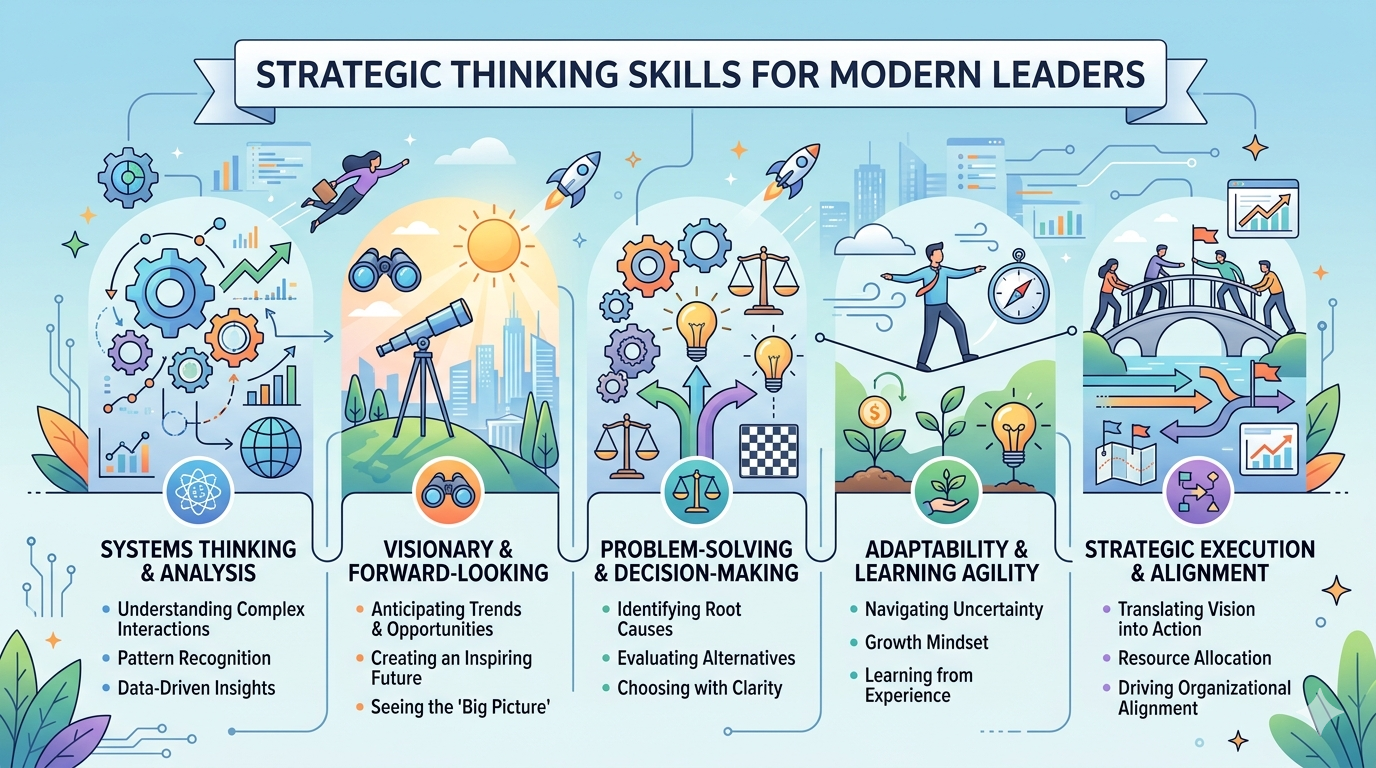
Diagram outlining components associated with strategic thinking
Disclaimer
This article is for general informational and educational purposes only. It does not constitute professional psychological, counseling, medical, or consumer purchasing advice. References to programs, books, tools, or methods do not imply endorsement or guarantee of results. Readers are encouraged to consult licensed professionals and verified educational sources when pursuing personal development.