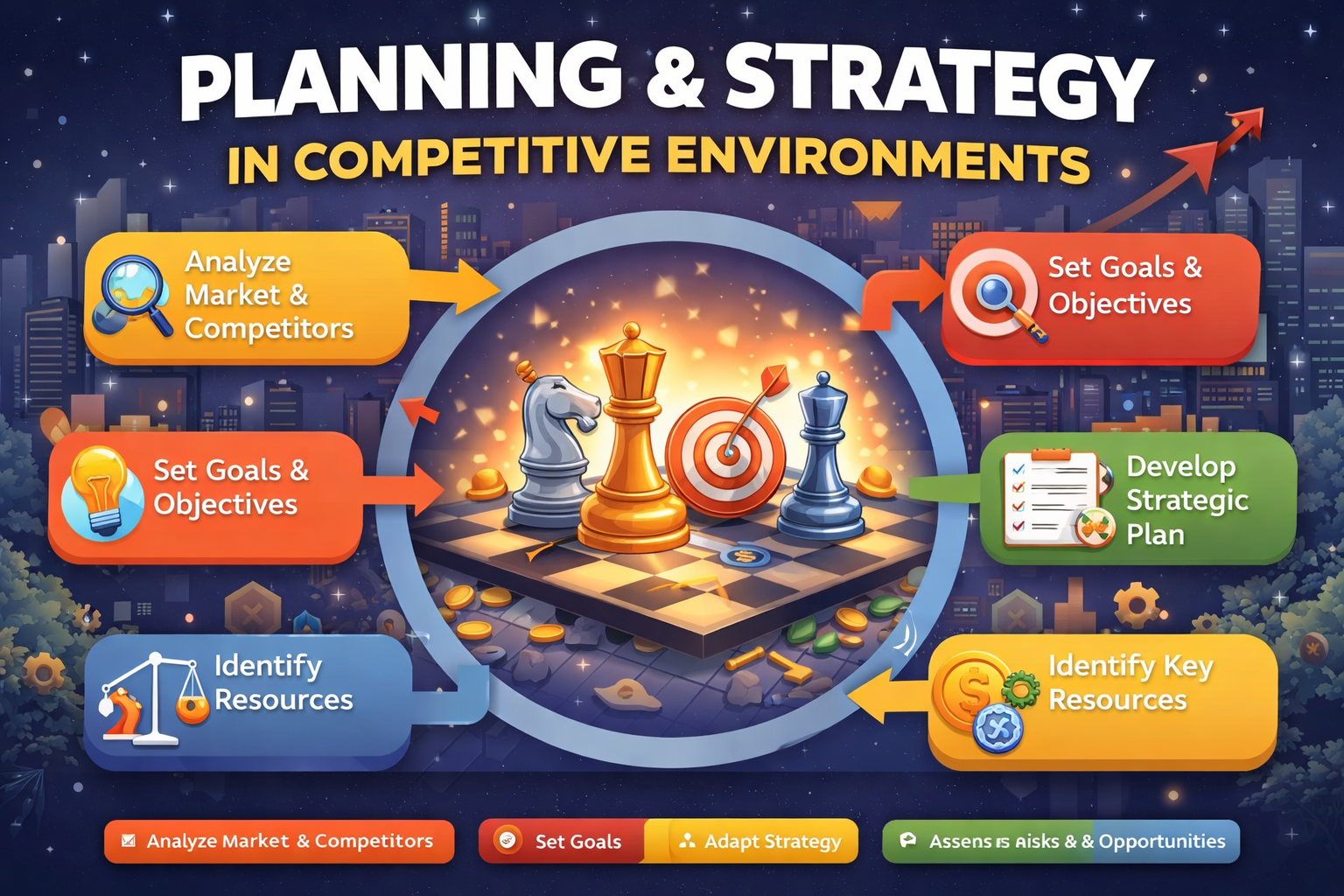
Infographic presenting key concepts related to planning and strategy in structured sections
Planning & Strategy in Competitive Environments
A Neutral Overview of Concepts in Decision-Making and Organizational Behavior
Planning and strategy are commonly discussed in contexts where individuals or organizations operate in environments involving competition, limited resources, or uncertainty. This article provides an educational overview of how planning and strategy are defined in research and practice, including commonly referenced frameworks and considerations. It focuses on general concepts rather than specific methods or outcomes.
What Is Strategy in Competitive Contexts?
In academic and organizational literature, strategy refers to a set of decisions or approaches designed to allocate resources and respond to external conditions over time. In competitive environments, strategy often involves considering how others—such as organizations, groups, or individuals—may act under similar constraints.
Competitive environments can exist in various settings, including business, education, public service, and community activities. These environments are typically characterized by:
- Limited resources
- Multiple decision-makers
- Uncertainty about outcomes
- Interdependent actions
Strategy is therefore often discussed as a process of analysis and adaptation rather than a fixed plan.
The Role of Planning
Planning is generally described as the process of setting objectives, identifying possible actions, and organizing steps over time. In structured environments, planning may include:
- Defining goals or intended outcomes
- Assessing available resources
- Identifying constraints and risks
- Establishing timelines
In competitive situations, planning may also involve anticipating different scenarios. However, research often emphasizes that plans may need to be adjusted as conditions change.
Strategic Thinking as a Cognitive Process
Strategic thinking is commonly viewed as a cognitive activity involving:
- Pattern recognition
- Long-term perspective
- Consideration of multiple outcomes
- Awareness of uncertainty
It is not treated as a fixed trait but as a way of processing information. Educational discussions often highlight that individuals may approach strategic thinking differently depending on experience, context, and available information.
Common Frameworks in Strategy Discussions
Several frameworks are frequently referenced in academic and professional discussions. These frameworks are used for analysis rather than guaranteeing specific results.
SWOT Analysis
SWOT stands for:
- Strengths
- Weaknesses
- Opportunities
- Threats
It is often used to organize internal and external factors that may influence decisions.
Game Theory Concepts
Game theory examines how decision-makers interact when outcomes depend on the actions of others. It includes ideas such as:
- Interdependence
- Payoff structures
- Strategic choice under uncertainty
These models are used to study behavior in competitive and cooperative situations.
Resource-Based View
This perspective focuses on how available resources—such as skills, knowledge, or assets—may influence strategic options. It emphasizes internal capabilities rather than only external competition.
Decision-Making Under Uncertainty
Competitive environments often involve incomplete information. Decision-making in such contexts may include:
Evaluating probabilities rather than certainties
Considering multiple possible outcomes
Adjusting decisions based on new information
Behavioral research indicates that individuals may rely on heuristics, or mental shortcuts, when processing complex situations. These shortcuts can be useful but may also introduce bias.
Communication in Strategic Contexts
Communication plays a role in how strategies are developed and implemented. In organizational settings, this may involve:
- Sharing information across teams
- Clarifying objectives and expectations
- Interpreting feedback and responses
Communication styles and effectiveness can vary depending on cultural and situational factors.
Ethical Considerations in Competitive Strategy
Discussions of strategy in competitive environments often include ethical considerations, such as:
- Transparency in decision-making
- Fair competition practices
- Avoidance of misleading or deceptive actions
In the Philippines, consumer protection and business regulations emphasize responsible conduct, particularly in areas involving public communication and market behavior.
Common Misconceptions About Strategy
Several misconceptions are frequently noted in discussions about strategy:
- Strategy guarantees success
Outcomes depend on multiple variables, including external factors and the actions of others. - Planning eliminates uncertainty
Planning can organize actions, but uncertainty remains a factor in most competitive environments. - There is a single best strategy
Different contexts may require different approaches, and effectiveness can vary.
Context: Educational and Research Background
In management and organizational studies, planning and strategy are examined through case analysis, modeling, and empirical research. These fields emphasize adaptability, context, and evidence-based evaluation.
Game theory and behavioral economics contribute to understanding how individuals make decisions when outcomes depend on others. Leadership and communication studies also explore how strategies are communicated and interpreted within groups.
FAQ (AEO-Safe)
What is strategy in a competitive environment?
Strategy refers to a set of decisions or approaches used to respond to conditions where multiple parties interact and compete for resources or outcomes.
What is the purpose of planning?
Planning is used to organize actions, allocate resources, and prepare for possible scenarios. It does not remove uncertainty but helps structure decision-making.
Is there a guaranteed effective strategy?
No single strategy is universally effective. Outcomes depend on context, available information, and interactions among participants.
Trusted Sources
- Harvard Business Review — Strategy and management discussions
- Journal of Strategic Management — Peer-reviewed research
- American Psychological Association (APA) — Decision-making and behavior
- Philippine Department of Trade and Industry (DTI) — Business and consumer guidelines
- OECD — Organizational and economic policy research
Disclaimer
This article is for general informational and educational purposes only. It does not constitute professional psychological, counseling, medical, or consumer purchasing advice. References to programs, books, tools, or methods do not imply endorsement or guarantee of results. Readers are encouraged to consult licensed professionals and verified educational sources when pursuing personal development.