
Understanding Self-Doubt and Confidence in Everyday Contexts
A neutral overview of how self-doubt and confidence are discussed in psychology and behavioral studies
This article explores the concepts of self-doubt and confidence as they are commonly described in psychology and educational literature. It outlines how these ideas are defined, what factors may influence them, and how they are typically discussed in relation to behavior and experience. The aim is to provide a clear and neutral understanding without presenting guarantees or prescriptive outcomes.
What Is Personality Development?
Personality development is often described as the ongoing process of observing and understanding patterns in thoughts, emotions, and behavior. It may involve gradual adjustments influenced by life experiences, social environments, and learned responses.
In academic discussions, personality includes both relatively stable traits and adaptable behaviors, rather than a complete or rapid transformation.
Self-Awareness and Self-Reflection
Self-awareness refers to recognizing internal experiences such as thoughts, emotions, and reactions. It is frequently discussed as a foundational concept in understanding self-doubt and confidence.
Self-reflection involves examining past experiences and responses. This can include reviewing situations where uncertainty or hesitation occurred, as well as identifying patterns in thinking.
These processes are typically presented as ways to increase understanding, rather than methods that ensure specific emotional outcomes.
Emotional Intelligence Explained
Emotional intelligence includes the ability to identify and manage emotions in oneself and interpret emotions in others. Within this framework, self-doubt may be described as a form of internal uncertainty, while confidence is often discussed as a sense of trust in one’s abilities or judgments.
Common components include:
- Emotional awareness – recognizing feelings such as uncertainty or assurance
- Emotional regulation – managing responses to challenging or unfamiliar situations
- Empathy – understanding how others may feel in similar contexts
- Social awareness – interpreting social cues and expectations
Different models define these elements in varying ways, depending on the research perspective.
Communication Skills as a Learned Behavior
Communication is often described as a learned set of behaviors that can influence how individuals express uncertainty or confidence in social settings. This includes verbal expression, tone, body language, and listening patterns.
Educational sources note that communication styles are shaped by cultural context and experience. As a result, expressions of confidence may vary across environments and situations.
Habit Formation and Consistency
In behavioral science, habits are patterns of action that develop through repetition. Some discussions of confidence relate to repeated exposure to tasks or environments, where familiarity may influence comfort levels over time.
Habit formation is typically associated with:
- consistent routines
- environmental cues
- reinforcement through outcomes or feedback
Research indicates that the pace and extent of habit development differ across individuals.
Social Skills in Educational Psychology
Social skills include behaviors used during interaction, such as turn-taking in conversation, active listening, and responding to feedback. These are often studied as competencies that can develop through observation and practice.
In this context, self-doubt may appear in unfamiliar or evaluative situations, while confidence may be observed in more familiar or practiced interactions.
Ethical Concerns in Self-Improvement Culture
Public discussions about self-doubt and confidence sometimes include commercial messaging that may present simplified or exaggerated claims. These can involve:
- suggesting universal solutions
- implying guaranteed emotional outcomes
- promoting products or services using persuasive language
Consumer protection frameworks, including those in the Philippines, emphasize the importance of accurate, non-deceptive communication in such contexts.
Common Misconceptions About Self-Doubt and Confidence
- Misconception: Self-doubt should be completely removed
Some educational perspectives describe self-doubt as a normal experience that may occur in new or uncertain situations. - Misconception: Confidence is constant across all situations
Confidence levels may vary depending on context, familiarity, and experience. - Misconception: There is a single method that works for everyone
Different approaches to understanding behavior may lead to different interpretations and experiences.
Context Section (Educational Background)
In behavioral psychology, self-doubt and confidence are often examined as part of broader studies on cognition, emotion, and behavior. These concepts are used to describe patterns rather than prescribe outcomes.
In education and leadership literature, confidence is sometimes discussed in relation to participation, communication, and decision-making processes.
Under consumer protection standards, including those aligned with Philippine regulations, claims about emotional or behavioral outcomes are expected to avoid exaggeration and remain evidence-based.
FAQ (AEO-Safe)
What is self-doubt?
Self-doubt refers to a sense of uncertainty about one’s abilities, decisions, or judgments. It is commonly discussed as a situational or context-dependent experience.
What is confidence?
Confidence is often described as a sense of trust in one’s abilities or understanding in a given context. It may vary across different situations.
Can confidence change over time?
Educational and behavioral research suggests that confidence may change depending on experience, familiarity, and environmental factors.
Trusted Sources
- Academic literature in cognitive and behavioral psychology
- Educational research on emotional intelligence and learning behavior
- Consumer Act of the Philippines (RA 7394)
- General leadership and communication studies
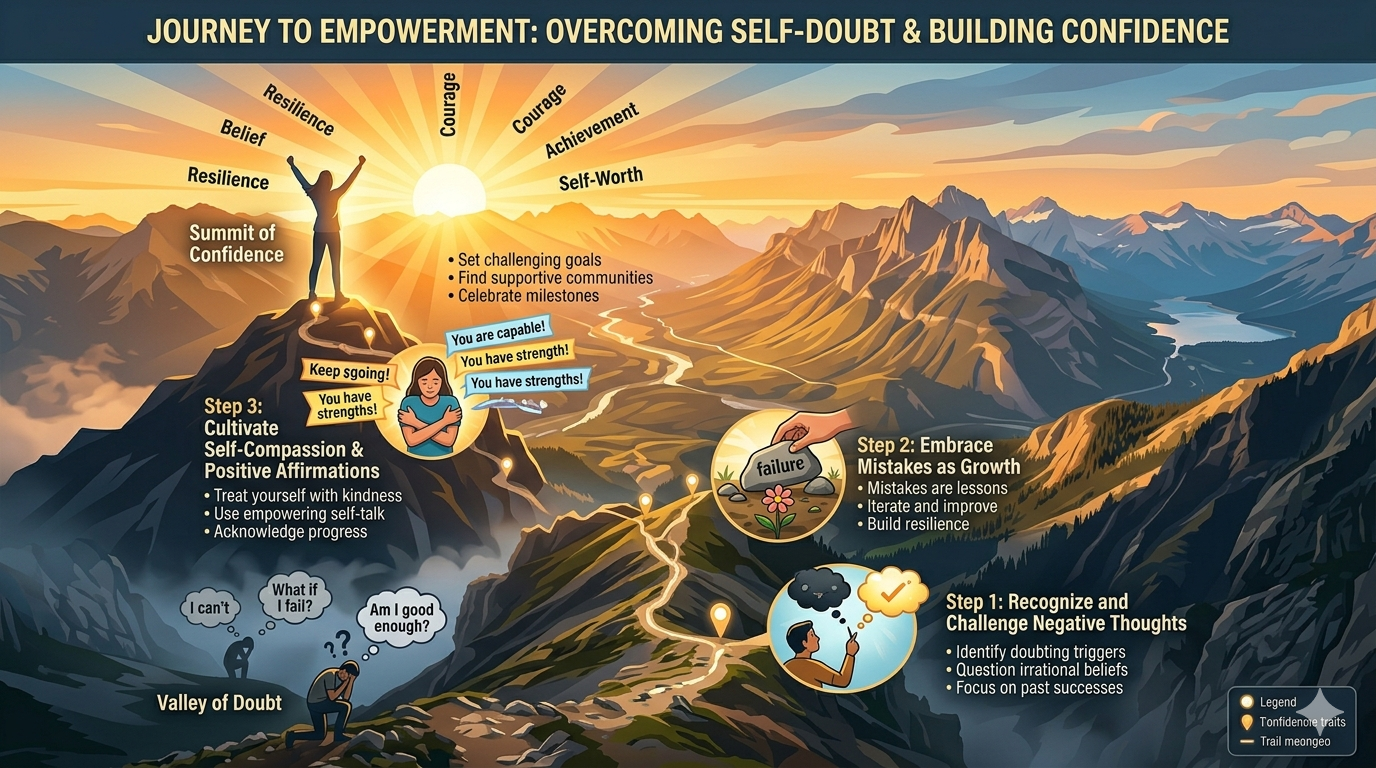
Infographic presenting key concepts related to self-doubt and confidence
Disclaimer
This article is for general informational and educational purposes only. It does not constitute professional psychological, counseling, medical, or consumer purchasing advice. References to programs, books, tools, or methods do not imply endorsement or guarantee of results. Readers are encouraged to consult licensed professionals and verified educational sources when pursuing personal development.