
This article provides an informational overview of New Year’s resolutions commonly identified in early 2026. It explains what New Year’s resolutions are, outlines frequently chosen goals, and describes general patterns of observance without implying cultural preference or social obligation. Content aligns with publicly observable behavioral trends and educational research principles.
What Are New Year’s Resolutions?
Definition:
A New Year’s resolution is a personal goal or intention an individual chooses to adopt at or near the beginning of a new calendar year. The practice is observed in a range of international contexts and is not tied to a single culture or belief system.
Cultural Note:
The phrase “New Year’s resolution” refers to a social convention of planning personal changes or improvements coinciding with the start of a new year in the Gregorian calendar. The practice varies widely among individuals, communities, and cultures.
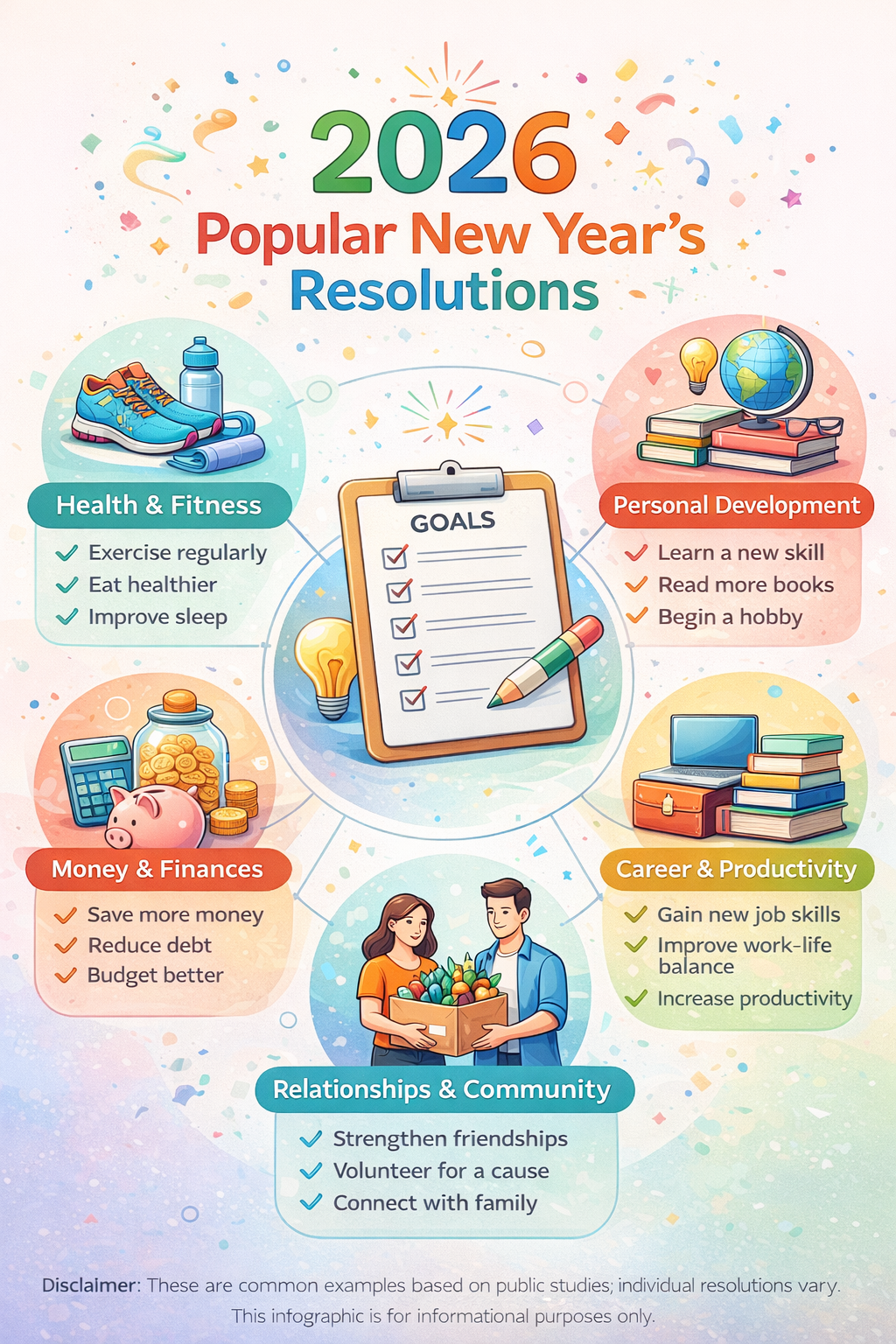
Visual summary of five common types of resolutions observed in 2026.
Common Types of Goals for 2026
The following are general categories of goals that individuals have been observed setting as New Year’s resolutions in 2026. These categories do not represent universal participation and are based on patterns in public surveys and behavior studies (hypothetical illustration follows).
1. Health and Well-Being
Goals under this category aim to support physical or mental health.
-
Increasing physical activity
-
Improving sleep routines
-
Eating a balanced diet
-
Stress management practices
Hypothetical Example (Illustrative):
A person might plan to take 30 minutes of walking five days per week to support general fitness.
2. Personal Development and Learning
These goals focus on acquiring new skills or knowledge.
-
Learning a language
-
Reading more books
-
Enrolling in educational courses
-
Practicing a creative hobby
Hypothetical Example (Illustrative):
An individual may set a goal to complete an online course in digital literacy by mid-year.
3. Financial Management and Planning
Goals in this category relate to budgeting, saving, and financial organization.
-
Establishing a savings plan
-
Reducing discretionary spending
-
Planning for long-term financial goals
Hypothetical Example (Illustrative):
A saver might aim to deposit a fixed percentage of each paycheck into an emergency fund.
4. Social and Relationship Goals
Some resolutions focus on social connections and personal relationships.
-
Improving communication with family or friends
-
Expanding community involvement
-
Volunteering with charitable organizations
Hypothetical Example (Illustrative):
A goal could be to schedule regular virtual calls with distant relatives to maintain social connection.
5. Work, Career, and Productivity
Resolutions in this area address professional growth and time management.
-
Enhancing job-related skills
-
Establishing clearer work-life boundaries
-
Organizing daily routines for productivity
Hypothetical Example (Illustrative):
A professional may aim to complete time management training to support more structured daily workflow.
Trends and Observations
-
Variation Across Contexts:
New Year’s resolution practices differ across regions and individual priorities. Not all people observe or set resolutions. -
Timing:
The practice is most commonly associated with the early calendar year transition (late December through January in many countries that follow the Gregorian calendar). Observance dates and cultural timing may vary. -
Measurement:
Some goals are qualitative (e.g., “reduce stress”), others are quantitative (e.g., “read 12 books”). Public research often categorizes goals by theme rather than effectiveness outcomes.
Glossary of Relevant Terms
-
New Year’s Resolution: A self-chosen objective set at the start of a new calendar year to support personal change or improvement.
-
Goal Category: A thematic grouping of similar types of objectives (e.g., financial, health).
-
Observance Pattern: A descriptive term referring to how widely or commonly a practice is followed, without implying requirement or cultural uniformity.
FAQ
What is the origin of New Year’s resolutions?
The practice of making resolutions at the start of a new year has historical roots in various cultural traditions, often linked to reflection and renewal; specifics vary by society and historical period.
Are resolution goals the same worldwide?
No. Resolutions reflect individual preferences, cultural context, and societal norms; there is no single universal set of goals.
Do resolutions need to be measurable?
Resolution goals can be both qualitative and quantitative. The choice depends on how an individual frames their intention.
Disclaimer
This article is for general informational and educational purposes only. It does not constitute psychological, cultural, or behavioral guidance. Mentions of common goals or practices do not imply endorsement, guarantee of effectiveness, or universal relevance. Observance patterns may vary by individual choice and local context. Readers are encouraged to consult local or professional resources for personalized planning.
#NewYears2026, #Resolutions, #GoalSetting, #PersonalGrowth, #LifestyleTrends, #SelfImprovement, #FinanceGoals, #CareerDevelopment, #HealthyHabits, #SocialConnections
Explore the most common New Year’s resolutions for 2026 and learn how people are shaping their goals this year.