Scope and Purpose
This article provides a neutral, research-informed overview of areas associated with observable demand signals in 2026 across career paths, business domains, investment themes, multi-level marketing structures, and skills development. The focus is analytical rather than predictive. It describes patterns that appear in labor statistics, institutional research publications, demographic studies, and regulatory discussions.
The term “opportunity” is used here in a descriptive sense. It refers to areas where measurable activity, resource allocation, or skill demand can be observed. It does not imply guaranteed outcomes, suitability for any specific individual, or financial gain. Outcomes vary depending on context, regulation, economic conditions, qualifications, and access to resources.
Global trend analysis typically relies on structured methodologies. These include longitudinal data comparisons, cross-regional labor reporting, macroeconomic indicators, and sector-based performance studies. Such methods identify demand signals without assuming certainty about future results.
The purpose of this overview is to improve understanding of how opportunity areas are identified and discussed in international research environments. It does not provide personal advice or promotional guidance.
Career Areas with Observable Demand Patterns
Labor market research across multiple regions frequently highlights sectors influenced by demographic change, technological integration, and regulatory requirements. Career demand is typically assessed using occupational growth projections, employer surveys, and workforce transition data.
Digital technology roles remain visible in employment outlook publications. Organizations across industries rely on data processing, cybersecurity frameworks, cloud infrastructure management, and software systems maintenance. These functions support both public and private institutions as digital transformation continues.
Healthcare and allied services are often referenced in workforce studies due to aging populations and expanded healthcare access. Roles in nursing, rehabilitation services, health administration, and medical technology support reflect structural demographic trends rather than short-term fluctuations.
Sustainability-related functions are associated with environmental compliance, energy reporting, renewable infrastructure projects, and resource efficiency monitoring. Regulatory frameworks in various jurisdictions require measurable environmental disclosures, contributing to specialized roles.
Education and skills facilitation positions reflect workforce adaptation. Instructional design, digital learning systems, and vocational retraining programs are frequently cited in research examining long-term labor market adjustments.
These areas represent demand signals documented in research, not guarantees of employment outcomes.
Business Domains with Active Market Engagement
Business activity in 2026 reflects structural shifts in consumer behavior, technological infrastructure, and environmental accountability. Observing engagement levels in specific sectors involves analyzing capital expenditure reports, industry studies, and regulatory filings.
Digital service infrastructure continues to adapt to distributed commerce systems. Logistics coordination platforms, online transaction processing tools, and data management services support organizations operating across borders. Growth in digital ecosystems often correlates with increased demand for technical maintenance, cybersecurity oversight, and compliance management.
Sustainability-adjacent enterprises are frequently discussed in environmental reporting frameworks. Businesses engaged in energy efficiency services, waste reduction technologies, and carbon reporting tools operate within regulatory and reporting structures that require measurable outcomes. These activities align with long-term environmental transition objectives rather than short-term speculative trends.
Health-oriented service models also appear in sector analysis. Administrative support systems, telehealth facilitation technologies, and preventive health programs are referenced in industry research addressing population needs.
Business engagement levels vary by jurisdiction, infrastructure capacity, and regulatory environment. Identifying active domains does not imply that any specific model will succeed. Market participation is influenced by operational competence, compliance adherence, cost management, and local economic conditions.
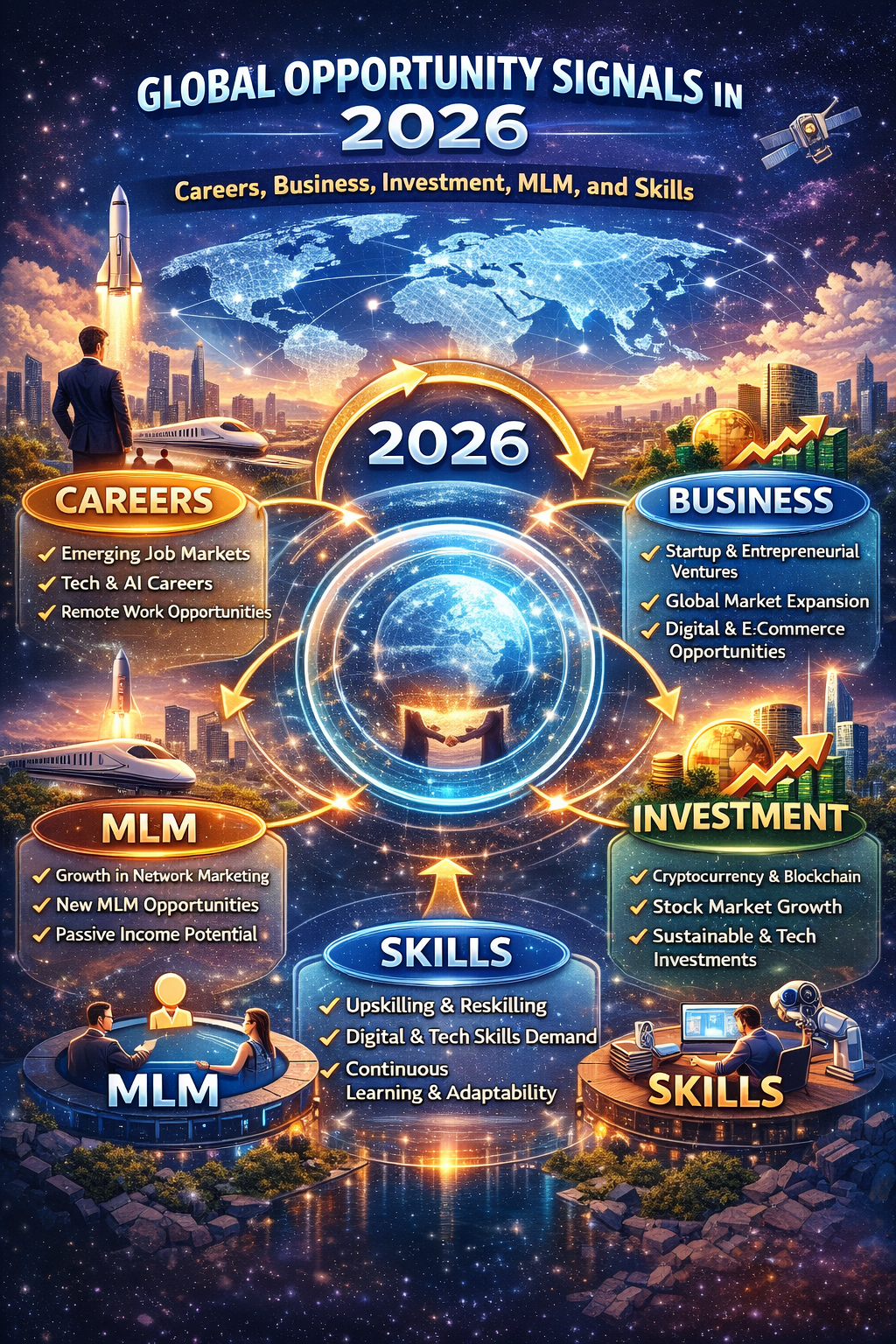
Infographic displaying global demand patterns in careers, business sectors, investment flows, MLM, and skill development.
Investment Themes Referenced in Institutional Research
Investment research institutions frequently categorize capital allocation into thematic segments to assess exposure and risk distribution. These themes are descriptive frameworks rather than recommendations.
Broad market index instruments are commonly referenced in long-term asset allocation discussions. Such instruments aim to track aggregate market performance across sectors, providing diversified exposure within a defined index methodology. Institutional reports often analyze historical volatility, drawdowns, and recovery cycles to contextualize these instruments.
Fixed income and sovereign securities remain components of diversified portfolios in many research models. Government-issued bonds and high-credit corporate instruments are evaluated for yield stability, credit risk, and duration sensitivity. Their performance is influenced by monetary policy, inflation expectations, and fiscal conditions.
Technology sector allocation is frequently examined in capital flow analysis. Institutional research explores innovation cycles, research and development expenditure, and adoption rates. Variability in valuation metrics is often discussed within risk assessment frameworks.
Investment themes are shaped by macroeconomic indicators, regulatory structures, and geopolitical considerations. Individual decisions depend on financial objectives, time horizons, and regulatory context. This overview does not endorse or recommend any allocation strategy.
Multi-Level Marketing (MLM): Structural and Regulatory Context
Multi-level marketing (MLM) models operate within defined regulatory frameworks in many jurisdictions. Oversight bodies distinguish between lawful direct selling models and unauthorized pyramid schemes based on compensation structure and product legitimacy.
A compliant MLM model generally includes verifiable product or service value independent of recruitment incentives. Regulatory agencies often examine compensation disclosures, refund policies, inventory requirements, and transparency in earnings representations. Documentation and contractual clarity are central compliance features.
Publicly available enforcement records from consumer protection agencies emphasize the importance of separating product-based revenue from recruitment-based compensation. In several jurisdictions, authorities require clear disclosure statements outlining income variability and participant risk.
Market participation patterns in MLM structures vary widely. Research often indicates significant differences between average participant earnings and advertised examples. This underscores the importance of reviewing official filings and documented disclosures.
Evaluating any network marketing structure requires attention to legal status, compensation documentation, and consumer rights protections applicable in a given region. This section provides structural context only and does not encourage participation.
Skills Development Areas with Ongoing Demand Signals
Skills development trends are frequently assessed through workforce readiness studies, employer surveys, and academic research examining technological adoption. In 2026, several foundational skill categories are repeatedly referenced in global reports.
Data literacy remains central to many professional environments. Basic statistical reasoning, interpretation of dashboards, and understanding of measurement limitations are increasingly integrated into diverse roles. Organizations rely on data-informed decision frameworks across sectors.
Digital tool proficiency extends beyond coding expertise. It includes cybersecurity awareness, cloud-based collaboration platforms, workflow automation tools, and digital documentation systems. As infrastructure becomes increasingly digitized, baseline technical familiarity is often required.
Communication and collaboration skills are consistently highlighted in workforce studies. Remote coordination, cross-cultural interaction, and structured problem-solving support distributed teams operating across time zones and regulatory environments.
Skills demand is shaped by structural technological shifts rather than isolated trends. However, proficiency levels required vary by role and region. Continuous learning patterns are frequently observed in labor market transitions, reflecting adaptation rather than guaranteed advancement outcomes.
Context: Structural vs. Cyclical Patterns
Opportunity analysis in global research environments distinguishes between structural and cyclical patterns. Structural trends represent long-term shifts driven by demographics, technological change, regulatory frameworks, or environmental transitions. Cyclical patterns reflect shorter-term economic fluctuations, such as changes in consumer spending, interest rates, or market sentiment.
For example, aging population data may indicate structural healthcare demand over decades. In contrast, quarterly hiring slowdowns may reflect cyclical economic adjustments. Separating these categories helps analysts avoid conflating temporary variation with systemic change.
Probability and uncertainty are central considerations in timing analysis. Historical pattern recognition can provide context, but it does not eliminate variability. External shocks, policy changes, or innovation breakthroughs can alter trajectories.
Recognizing demand signals requires verification through multiple sources, including official statistics, academic research, and institutional reporting. Misinterpretation of isolated data points may lead to inaccurate conclusions.
Understanding the distinction between structural and cyclical dynamics supports informed evaluation. However, it does not determine outcomes or eliminate risk.
Educational Glossary
Trend Analysis
A research method involving systematic review of historical and current data to identify recurring patterns. It does not assume future certainty.
Demand Signal
Observable evidence of engagement, hiring activity, capital allocation, or consumer participation within a sector.
Risk Profile
An analytical characterization of uncertainty, volatility, and potential variability associated with a domain or allocation category.
Structural Shift
A long-term transformation in economic, demographic, technological, or regulatory systems influencing activity patterns.
Cyclical Variation
Short-term fluctuation linked to economic cycles, seasonal effects, or temporary policy adjustments.
Regulatory Compliance
Adherence to applicable consumer protection laws, financial disclosure standards, and market conduct rules within a jurisdiction.
FAQ
What defines an opportunity in economic research?
An opportunity is typically identified through observable demand signals, measurable gaps in service provision, or efficiency differentials. It reflects conditions, not guaranteed results.
How is career demand typically measured?
Career demand is measured through occupational projections, employer surveys, demographic studies, and government labor statistics. These sources provide directional context rather than certainty.
What should be examined in network marketing models?
Evaluation typically includes compensation transparency, regulatory status, verifiable product demand, contractual terms, and consumer protection safeguards.
Disclaimer
This article is for general informational and educational purposes only. It does not constitute professional financial, investment, legal, academic, or career advice. References to trends, timing strategies, probabilities, or opportunities do not imply endorsement or guarantee of outcomes. Readers are encouraged to verify information through official and reputable sources and exercise independent judgment when making decisions.
#GlobalTrends2026, #CareerInsights, #BusinessPatterns, #InvestmentSignals, #SkillDevelopment, #MLMStructures, #WorkforceEvolution, #MarketAnalysis, #OpportunitySignals, #EducationalOverview
Explore the latest educational insights on global opportunity signals in 2026 across careers, business, investment, MLM, and skills—delve into the full analysis here.