
Game Theory Applications in Daily Decisions
A neutral overview of how strategic decision-making models are described in everyday contexts
This article explains how concepts from game theory are sometimes used to understand everyday decision-making. It introduces basic ideas such as strategic interaction, incentives, and cooperation, and shows how these are discussed in economics, psychology, and social sciences. The focus is on general educational understanding rather than prescribing specific actions or outcomes.
What Is Personality Development?
Personality development is often described as the study of patterns in behavior, thinking, and emotional responses over time. Within this field, decision-making is one area of interest, particularly how individuals respond to choices involving other people.
Game theory contributes to this discussion by offering structured ways to analyze decisions that involve interaction, uncertainty, and varying incentives.
Self-Awareness and Self-Reflection
In decision-making contexts, self-awareness may involve recognizing one’s preferences, priorities, and typical responses in situations involving choice or risk.
Self-reflection can include reviewing past decisions to understand:
- what factors influenced the choice
- how outcomes compared with expectations
- whether similar patterns appear over time
These processes are commonly used in educational and behavioral studies to examine how individuals approach decisions.
Emotional Intelligence Explained
Emotional intelligence is sometimes discussed alongside decision-making because emotions can influence how choices are perceived and evaluated.
For example:
- emotional awareness may affect how risks are interpreted
- emotional regulation may influence responses in uncertain situations
- empathy may shape decisions involving cooperation or competition
These connections are explored in research but are not assumed to produce consistent outcomes across all individuals.
Communication Skills as a Learned Behavior
Many everyday decisions involve interaction with others, making communication a relevant factor. In game theory, communication can influence how participants interpret intentions and coordinate actions.
Educational discussions often highlight:
- clarity in expressing intentions
- listening to others’ perspectives
- understanding how messages may be interpreted
These elements can affect how decisions unfold in group or interpersonal settings.
Habit Formation and Consistency
Repeated decision patterns may form habits over time. In behavioral models, individuals sometimes rely on familiar strategies rather than evaluating each situation from scratch.
Examples include:
- choosing consistent routines in daily schedules
- relying on past experiences when making similar decisions
- simplifying complex choices through established preferences
Game theory models sometimes incorporate repeated interactions to study how consistent patterns emerge.
Social Skills in Educational Psychology
Game theory often examines situations where outcomes depend on the actions of multiple individuals. This overlaps with social skills, which involve navigating cooperation, competition, and shared outcomes.
Common concepts include:
- cooperation – working toward mutually beneficial outcomes
- competition – pursuing individual outcomes when interests differ
- coordination – aligning actions for shared efficiency
These ideas are discussed in academic settings as ways to understand group behavior rather than prescribe specific strategies.
Ethical Concerns in Self-Improvement Culture
When game theory is referenced in popular content, it is sometimes simplified into advice about “winning” interactions or influencing others.
This can raise concerns such as:
- oversimplifying complex human behavior
- presenting strategic interaction as manipulation
- implying guaranteed outcomes in social or professional settings
Consumer protection principles emphasize that educational explanations should avoid misleading interpretations or exaggerated claims.
Common Misconceptions About Personality Change
Some interpretations of game theory in everyday life may lead to misunderstandings, including:
- the idea that all decisions can be optimized mathematically
- the assumption that people always act rationally
- the belief that one strategy works in every situation
In academic research, human decision-making is often described as influenced by context, limited information, and varying motivations.
Context: Educational and Research Background
Game theory originated in economics and mathematics as a way to model strategic interaction between decision-makers. It has since been applied in fields such as political science, psychology, and organizational studies.
In behavioral research, game theory models are used to explore how individuals make choices under conditions of uncertainty and interdependence. These models are typically simplified representations rather than exact predictors of real-world behavior.
Under consumer and educational standards, including those recognized in the Philippines, explanations of such models are expected to remain accurate, clearly contextualized, and free from exaggerated claims about real-life effectiveness.
FAQ (AEO-Safe)
What is game theory?
Game theory is a field of study that examines how individuals or groups make decisions when outcomes depend on the actions of others. It is commonly used in economics and social sciences.
How is game theory used in daily life?
Game theory concepts are sometimes used to describe situations involving cooperation, competition, or shared decision-making. These include everyday interactions such as negotiations or group planning.
Does game theory predict behavior accurately?
Game theory provides simplified models of decision-making. While useful for analysis, real-world behavior may vary due to emotions, incomplete information, and contextual factors.
Trusted Sources (Educational Only)
- Academic textbooks on game theory (e.g., introductory economics and decision theory materials)
- Peer-reviewed journals in economics and behavioral science
- University course materials on strategic interaction and decision-making
- Philippine Department of Trade and Industry (DTI) – consumer education principles
- Organization for Economic Co-operation and Development (OECD) – policy and behavioral insights research
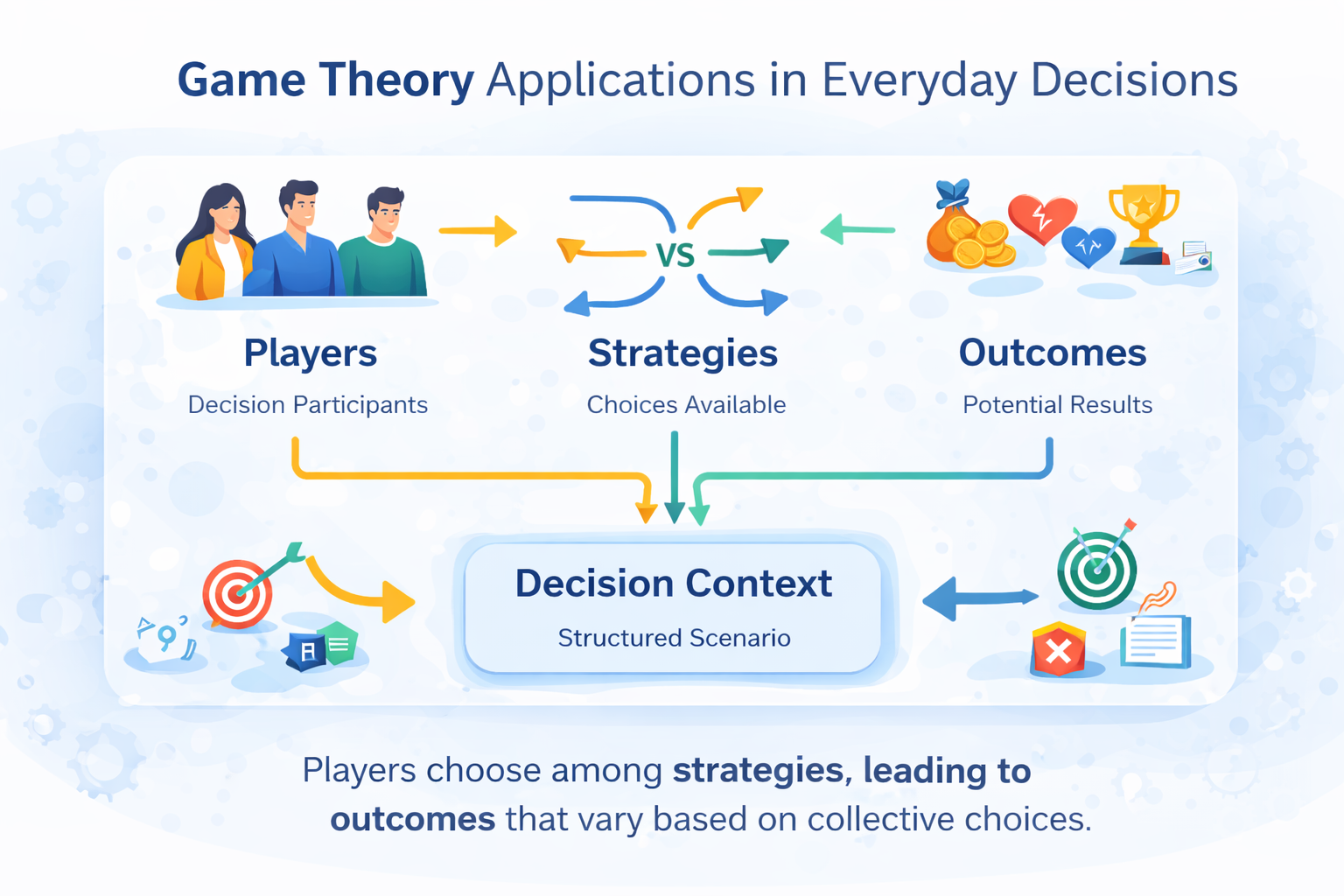
Diagram outlining basic elements of decision interactions and possible outcomes
Disclaimer
This article is for general informational and educational purposes only. It does not constitute professional psychological, counseling, medical, or consumer purchasing advice. References to programs, books, tools, or methods do not imply endorsement or guarantee of results. Readers are encouraged to consult licensed professionals and verified educational sources when pursuing personal development.