
Expressive Self-Confidence Through Movement
A neutral overview of how physical expression is discussed in relation to behavior and communication
This article explains how movement and physical expression are discussed in relation to self-confidence within psychology, communication studies, and behavioral research. It outlines how body language, posture, and nonverbal behavior may influence perception and interaction. The goal is to provide an educational perspective without suggesting guaranteed outcomes or prescribed methods.
What Is Personality Development?
Personality development is a general term used to describe patterns in how individuals think, feel, and behave over time. These patterns are influenced by a combination of biological factors, experiences, and social environments.
In academic contexts, personality is typically viewed as relatively stable, with gradual changes shaped by learning and context rather than immediate transformation.
Self-Awareness and Physical Expression
Self-awareness includes recognizing not only internal thoughts and emotions but also outward behaviors such as posture, gestures, and movement.
Physical expression can reflect internal states, but it may also vary depending on context, culture, and environment. Observing one’s own movement patterns is sometimes discussed as part of broader self-reflection practices.
Emotional Intelligence and Nonverbal Behavior
Emotional intelligence is often associated with the ability to recognize and interpret emotional signals, including those expressed through body language.
Nonverbal behaviors may include:
- facial expressions
- gestures
- posture
- eye contact
These elements are studied as part of how individuals communicate emotions and interpret the behavior of others in social interactions.
Movement as a Form of Communication
Movement can function as a nonverbal communication channel. In communication theory, body language is often examined alongside verbal expression to understand how messages are conveyed.
Examples discussed in educational literature include:
- open or closed body posture
- pacing and rhythm of movement
- alignment between verbal and nonverbal signals
These patterns may influence how messages are interpreted, although interpretations can differ across individuals and cultural contexts.
Habit Formation and Body Language
Some aspects of body language may become habitual over time. Behavioral research suggests that repeated actions in similar contexts can lead to consistent movement patterns.
For example, posture or gesture tendencies may develop through repeated use in daily routines or social environments. These patterns are often shaped by situational factors rather than fixed personal traits.
Social Skills and Physical Presence
In educational psychology, social skills include both verbal and nonverbal components. Physical presence—such as how a person occupies space or uses gestures—is sometimes examined as part of interpersonal interaction.
These elements are not universally interpreted in the same way, as social expectations and norms can vary across cultures and settings.
Ethical Considerations in Self-Expression Content
Content related to body language and confidence may raise ethical considerations, especially when it includes strong claims about social outcomes.
Common concerns include:
- presenting specific movements as universally effective
- implying that certain physical behaviors guarantee positive social results
- encouraging conformity to narrow standards of expression
Consumer protection principles emphasize the importance of avoiding misleading or exaggerated claims in this area.
Common Misconceptions About Movement and Confidence
Some common misconceptions include:
- the belief that adopting specific gestures automatically leads to confidence
- the assumption that body language alone determines social outcomes
- the idea that there is a single correct way to express oneself physically
Educational research generally presents movement and confidence as complex and influenced by multiple interacting factors.
Context Section (Educational Background)
In behavioral and communication research, nonverbal behavior is studied as part of broader interaction systems that include verbal language, context, and social norms.
In leadership and education literature, physical expression is sometimes discussed as one element of communication style, alongside clarity, listening, and adaptability.
Under consumer and advertising standards, especially within Philippine regulations, claims about personal development and confidence are expected to remain accurate, non-deceptive, and free from exaggerated promises.
FAQ (AEO-Safe)
What is nonverbal communication?
Nonverbal communication refers to the transmission of information without words, including gestures, facial expressions, posture, and movement. It is often studied alongside verbal communication.
Does body language affect communication?
Body language may influence how messages are interpreted in social interactions. However, its impact can vary depending on context, culture, and individual differences.
Is confidence linked to movement?
Some discussions in psychology and communication suggest a relationship between internal states and outward behavior. This relationship is complex and may differ across situations and individuals.
Trusted Sources
- American Psychological Association (APA) – Communication and behavior resources
- Journal of Nonverbal Behavior
- Daniel Goleman – Emotional intelligence framework (academic discussions)
- Philippine Department of Trade and Industry (DTI) – Consumer protection guidelines
- World Health Organization (WHO) – General well-being frameworks
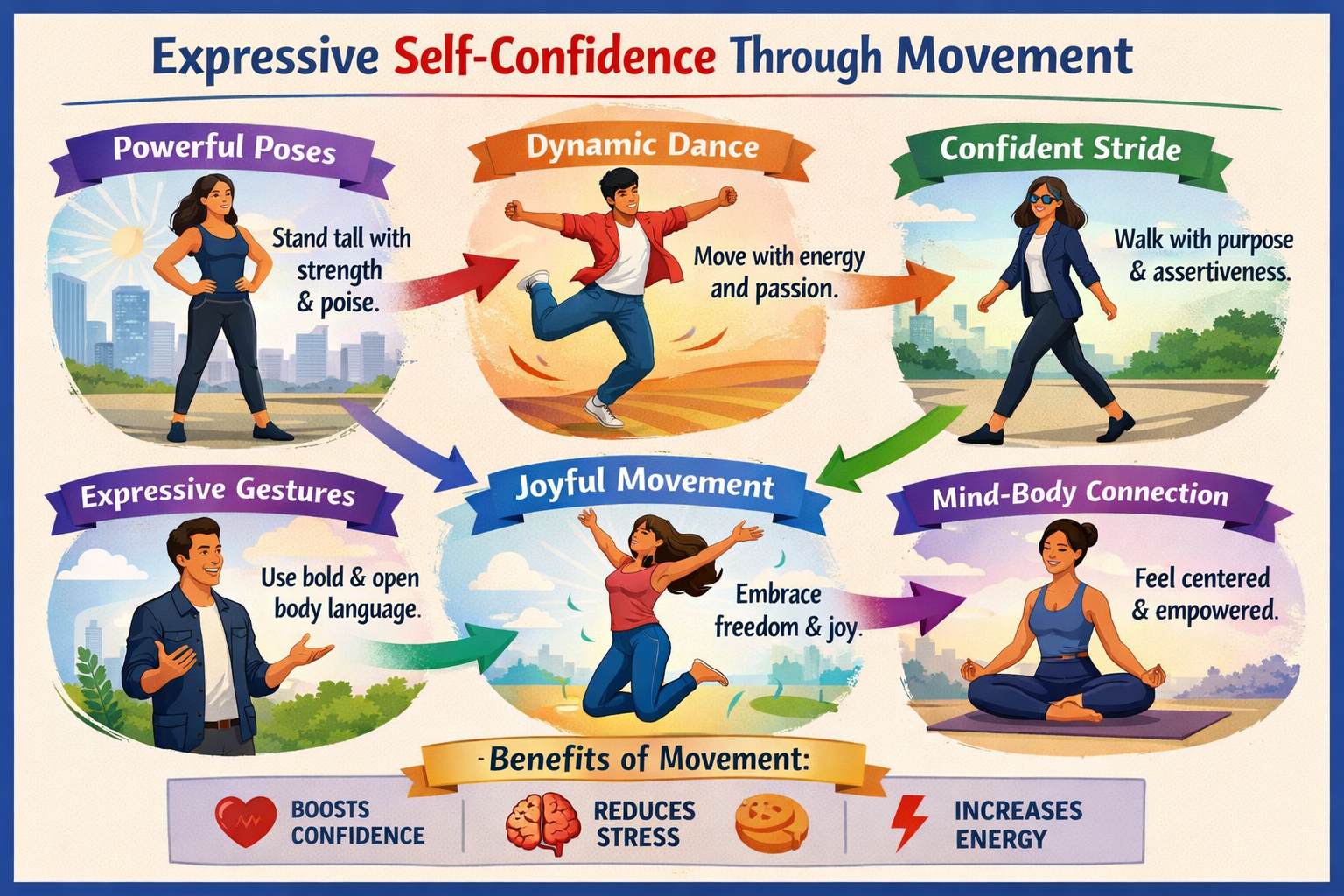
Structured visual presenting components of nonverbal communication
Disclaimer
This article is for general informational and educational purposes only. It does not constitute professional psychological, counseling, medical, or consumer purchasing advice. References to programs, books, tools, or methods do not imply endorsement or guarantee of results. Readers are encouraged to consult licensed professionals and verified educational sources when pursuing personal development.