
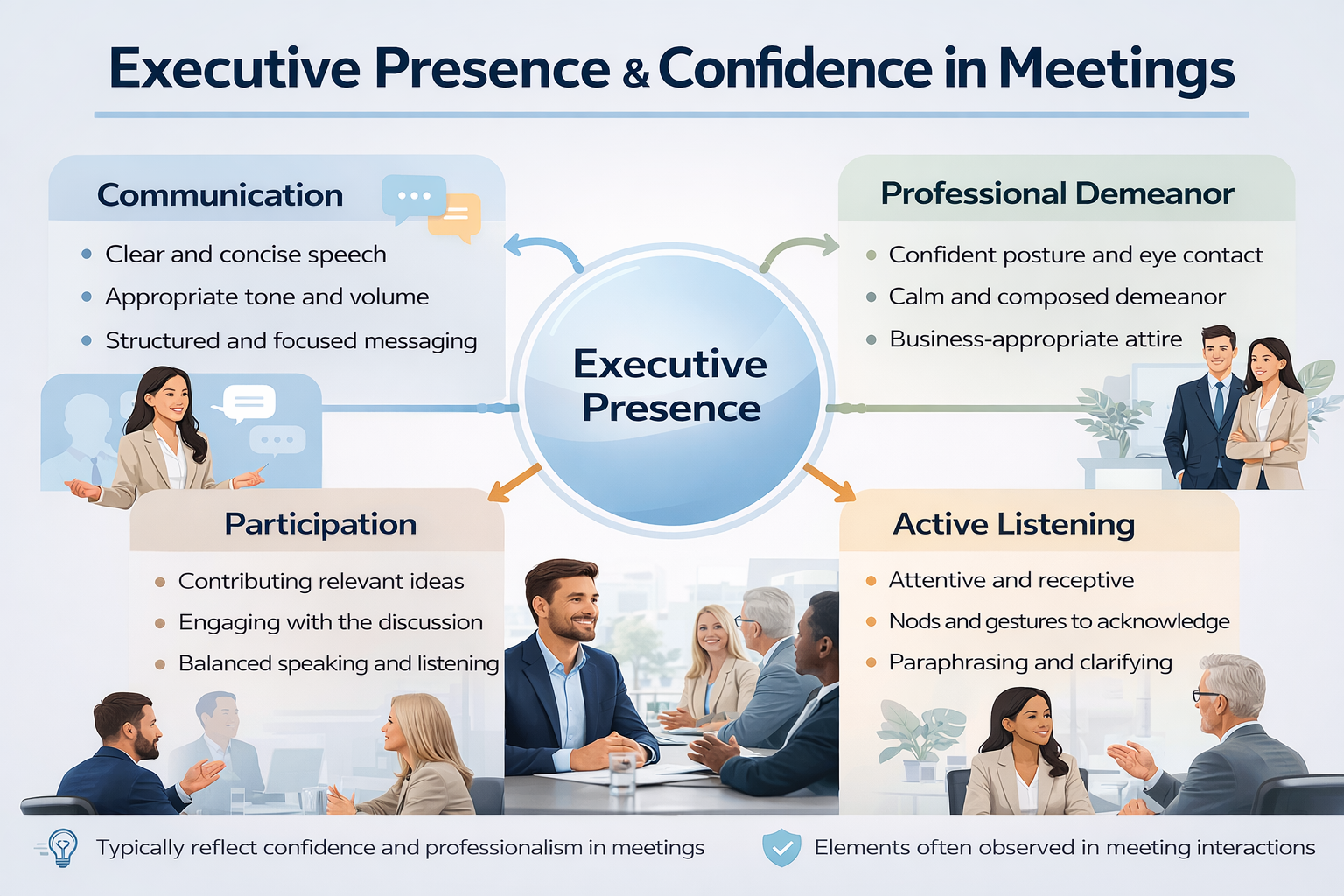
Visual layout of communication and interaction elements in meeting environments
Executive Presence and Confidence in Meetings
A Neutral Overview of Communication, Behavior, and Perception in Professional Settings
This article provides an educational overview of how executive presence and confidence are commonly discussed in workplace communication. It explains general concepts related to behavior, perception, and interpersonal interaction in meetings. The goal is to clarify how these ideas are defined in research and professional literature, without suggesting guaranteed outcomes or specific behavioral prescriptions.
What Is Executive Presence?
Executive presence is a term often used in leadership and organizational discussions. It generally refers to how an individual is perceived in professional settings, particularly in terms of communication style, composure, and clarity of expression.
In many descriptions, executive presence is not treated as a fixed trait. Instead, it is viewed as a combination of observable behaviors and contextual factors, such as:
- clarity when presenting ideas
- attentiveness during discussions
- consistency in verbal and nonverbal communication
Different organizations and cultures may interpret this concept in varied ways.
Understanding Confidence in Meetings
Confidence in meetings is commonly described as a communication-related behavior rather than a permanent personality characteristic. It may involve:
- speaking in a steady and understandable manner
- contributing ideas when appropriate
- maintaining awareness of the discussion context
In communication research, confidence is often linked to familiarity with the subject matter and prior experience in similar situations. It is not universally defined and may appear differently across individuals.
Self-Awareness and Behavioral Observation
Self-awareness is frequently discussed as a foundational concept in personality and leadership literature. It refers to the ability to observe one’s own behavior, thoughts, and reactions.
In meeting contexts, self-awareness may include:
- noticing speaking patterns
- recognizing how others respond during interactions
- reflecting on participation levels
Educational materials often describe self-awareness as something that can be explored through observation and reflection over time.
Communication Patterns in Meetings
Communication in meetings involves both verbal and nonverbal elements. Commonly studied aspects include:
- tone and pacing of speech
- clarity of message structure
- body language and eye contact
Research in interpersonal communication suggests that clarity and organization of ideas can influence how messages are received. However, interpretations of communication style can vary depending on cultural and organizational norms.
Behavioral Consistency and Habit Formation
In behavioral science, habits are patterns that develop through repeated actions in specific contexts. When applied to meetings, this may relate to:
- preparing talking points in advance
- listening before responding
- maintaining consistent participation over time
Habit formation is generally described as gradual and context-dependent. Outcomes can differ based on environment, experience, and individual preferences.
Social Perception in Professional Settings
Social perception refers to how individuals interpret and form impressions of others. In meetings, this may involve:
- interpreting communication style
- assessing clarity and relevance of contributions
- forming general impressions based on interaction patterns
Educational discussions emphasize that perception is subjective and influenced by multiple factors, including organizational culture and prior expectations.
Ethical Considerations in Workplace Communication
In professional environments, communication practices are often guided by principles such as respect, clarity, and inclusivity.
Ethical considerations may include:
- allowing balanced participation
- avoiding interruption or dominance in discussions
- recognizing diverse communication styles
These considerations are typically framed as part of broader workplace standards rather than individual performance metrics.
Common Misconceptions About Executive Presence
Some discussions of executive presence include assumptions that may not reflect research-based understanding. Examples include:
- the idea that it is an inborn trait rather than a set of behaviors
- the belief that one communication style applies universally
- the expectation of consistent interpretation across all audiences
Educational sources generally highlight that professional communication is influenced by context, experience, and social dynamics.
Context: Educational and Research Background
In behavioral psychology research, communication and confidence are often studied as observable behaviors shaped by environment and experience.
In leadership and organizational literature, executive presence is discussed as a descriptive concept rather than a standardized measurement.
Under consumer protection and educational standards, it is important to distinguish between general informational content and claims of guaranteed personal or professional outcomes.
FAQ
What is executive presence?
Executive presence is commonly described as a combination of communication style, composure, and clarity in professional settings. Definitions may vary depending on context.
What is confidence in meetings?
Confidence in meetings is often discussed as a behavior related to communication, such as speaking clearly and participating appropriately. It may be influenced by experience and familiarity with the topic.
How is self-awareness related to communication?
Self-awareness involves observing one’s own behavior and reactions. In communication, it may help individuals understand how they participate and interact in discussions.
Trusted Sources
- Organizational behavior and leadership literature (general academic publications)
- Interpersonal communication studies in educational psychology
- Professional workplace communication research from recognized academic institutions
- Philippine Department of Trade and Industry (DTI) consumer education materials on responsible communication
Disclaimer
This article is for general informational and educational purposes only. It does not constitute professional psychological, counseling, medical, or consumer purchasing advice. References to programs, books, tools, or methods do not imply endorsement or guarantee of results. Readers are encouraged to consult licensed professionals and verified educational sources when pursuing personal development.