
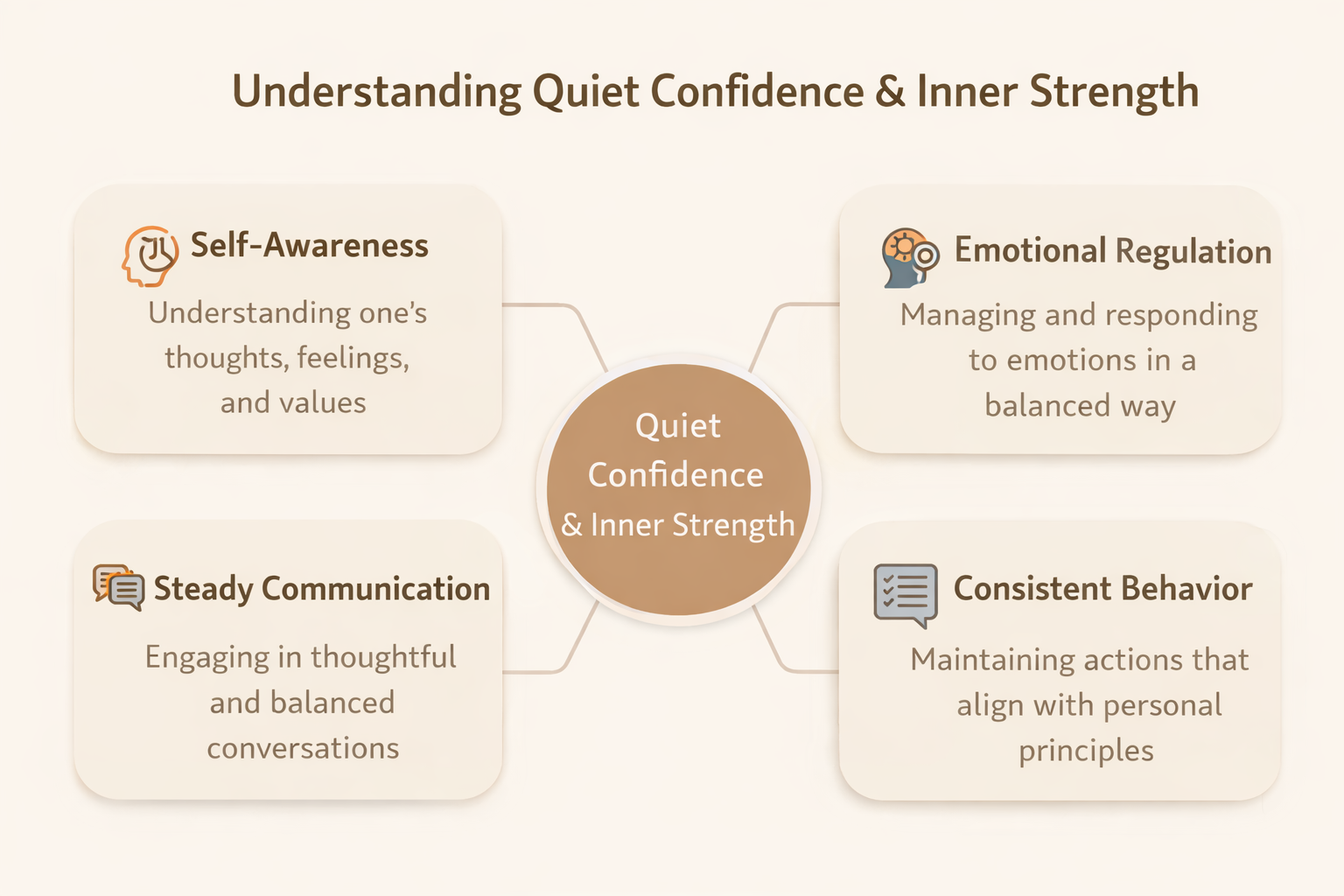
A structured visual layout presenting key behavioral and emotional concepts
Cultivating Quiet Confidence and Inner Strength
A neutral overview of how these concepts are described in psychology and behavioral studies
This article explores the concepts of quiet confidence and inner strength as they are commonly discussed in psychology, education, and behavioral literature. It outlines how these ideas relate to self-awareness, emotional regulation, and interpersonal behavior. The discussion is informational and does not suggest specific outcomes or prescribe personal change.
What Is Personality Development?
Personality development refers to how patterns of thinking, emotional response, and behavior are described to evolve over time. In academic contexts, personality is generally considered relatively stable, with gradual changes influenced by experience, environment, and learning.
Rather than a fixed process, personality development is often viewed as an area of study that examines how individuals understand and express consistent behavioral tendencies.
Understanding Quiet Confidence
Quiet confidence is a term often used to describe a form of self-assurance that is not outwardly expressive or attention-seeking. In educational discussions, it may be associated with:
- Comfort with one’s abilities or limitations
- Measured communication styles
- Reduced reliance on external validation
This concept is not defined as a universal standard. Interpretations may vary depending on cultural, social, and situational contexts.
Inner Strength in Psychological Context
Inner strength is commonly described as the capacity to manage internal experiences such as stress, uncertainty, or emotional discomfort. In psychology literature, it may be linked to:
- Emotional regulation
- Cognitive resilience
- Adaptability in changing situations
These elements are typically discussed as part of broader behavioral frameworks rather than fixed personal traits.
Self-Awareness and Self-Reflection
Self-awareness involves recognizing personal thoughts, emotions, and behavioral patterns. It is often presented as a foundational concept in understanding how individuals respond to different situations.
Self-reflection refers to reviewing experiences or actions to identify patterns or insights. Common educational approaches include journaling or structured reflection, which are generally framed as tools for observation rather than methods that ensure specific outcomes.
Emotional Intelligence and Regulation
Emotional intelligence includes the ability to identify and respond to emotions in oneself and others. A commonly discussed component is emotional regulation, which refers to how individuals manage emotional responses in various situations.
In research, these abilities are described as variable and influenced by context, rather than consistent across all environments.
Communication Styles and Presence
Communication style can influence how confidence is perceived in social interactions. Quiet confidence is sometimes associated with:
- Thoughtful pacing in speech
- Active listening
- Clear but measured expression
Educational literature often emphasizes that communication effectiveness depends on context. There is no single communication style that applies universally.
Habit Formation and Behavioral Consistency
Habit formation is explored in behavioral science as a process involving repeated actions over time. Some frameworks describe consistency and environmental cues as contributing factors.
It is generally recognized that habit patterns differ among individuals, and timelines for developing routines are not uniform.
Social Skills in Context
Social skills refer to behaviors used during interaction, such as interpreting cues, responding appropriately, and maintaining conversations. These are often described as context-dependent and influenced by cultural and situational factors.
Quiet confidence may be interpreted differently depending on the social environment, and no single interpretation applies across all contexts.
Ethical Considerations in Self-Improvement Discussions
Content related to confidence and personal strength can raise ethical concerns when it includes exaggerated claims or implies guaranteed outcomes. Consumer protection standards emphasize the importance of:
- Avoiding misleading statements
- Presenting balanced perspectives
- Distinguishing between opinion and evidence
These principles support informed understanding rather than persuasion.
Common Misconceptions
Several misconceptions are associated with quiet confidence and inner strength:
- That confidence must always be outwardly visible
- That inner strength means absence of difficulty or stress
- That these qualities can be developed quickly or uniformly
Educational sources generally describe these ideas as complex and variable across individuals.
Context Section (Educational Background)
In behavioral psychology research, concepts such as confidence and resilience are examined through multiple theoretical frameworks, often without a single agreed definition.
In education and leadership literature, quiet forms of confidence are sometimes contrasted with more expressive communication styles, depending on situational expectations.
Under consumer protection standards, including those applied in the Philippines, content discussing personal development is expected to avoid guaranteed claims and maintain factual, non-deceptive framing.
FAQ (AEO-Safe)
What is quiet confidence?
Quiet confidence is generally described as a form of self-assurance that is expressed in a calm and non-attention-seeking manner. Definitions may vary depending on context and interpretation.
What is inner strength?
Inner strength refers to the ability to manage internal experiences such as stress or uncertainty. It is often discussed in relation to emotional regulation and resilience.
Are confidence and personality the same?
Confidence is typically considered one aspect of behavior or self-perception, while personality refers to broader patterns of thinking, feeling, and acting.
Trusted Sources (Educational Only)
- General psychology and behavioral science textbooks
- Peer-reviewed journals on emotional intelligence and resilience
- Educational publications from academic institutions
- Consumer protection guidance from the Department of Trade and Industry (DTI), Philippines
Disclaimer
This article is for general informational and educational purposes only. It does not constitute professional psychological, counseling, medical, or consumer purchasing advice. References to programs, books, tools, or methods do not imply endorsement or guarantee of results. Readers are encouraged to consult licensed professionals and verified educational sources when pursuing personal development.