
Career-Oriented Strategic Decision Making
A Neutral Overview of Decision-Making Concepts in Career Contexts
This article explains how strategic decision-making is discussed in relation to career development. It outlines general frameworks used in education, management studies, and behavioral research to understand how individuals evaluate options, consider long-term directions, and respond to changing circumstances. The focus is on concepts and models rather than specific advice or outcomes.
What Is Career-Oriented Strategic Decision Making?
Career-oriented strategic decision making refers to the process of evaluating work-related options using structured thinking and long-term considerations. It is often discussed in fields such as management, education, and organizational behavior.
In academic contexts, this process may involve identifying goals, assessing available information, and considering possible consequences. It does not assume a fixed path or guaranteed result, as career trajectories can vary widely across individuals and environments.
Self-Awareness in Career Decisions
Self-awareness is frequently described as a factor in how individuals interpret career options. It may include:
- recognizing personal interests
- identifying strengths and limitations
- understanding work preferences and values
In educational literature, self-awareness is not treated as a one-time insight but as an ongoing process that may evolve over time.
Information Gathering and Evaluation
Strategic decision-making often involves collecting and reviewing information before making a choice. Common areas of consideration may include:
- job role descriptions and responsibilities
- required skills or qualifications
- industry trends and labor market conditions
- organizational culture and work environment
Decision-making models in management studies emphasize that information may be incomplete or subject to change, which can influence outcomes.
Goal Setting and Time Horizons
Career decisions are sometimes analyzed using different time perspectives:
- short-term considerations (e.g., immediate employment needs)
- medium-term considerations (e.g., skill development or role progression)
- long-term considerations (e.g., career direction over several years)
Educational frameworks often describe goals as flexible and subject to revision based on new information or experiences.
Decision-Making Models in Career Contexts
Several general models are used to describe how decisions are made:
Rational Decision-Making Model
This model involves identifying options, evaluating alternatives, and selecting a course of action based on available information.
Bounded Rationality
This concept suggests that decision-making is limited by factors such as time, information, and cognitive capacity. As a result, individuals may choose options that are satisfactory rather than optimal.
Incremental Decision-Making
In some cases, decisions are made gradually through small adjustments rather than large, one-time choices.
These models are descriptive and may be applied differently depending on context.
Risk, Uncertainty, and Trade-Offs
Career-related decisions often involve uncertainty. Outcomes may depend on external factors such as economic conditions, organizational changes, or evolving job markets.
Trade-offs are also commonly discussed. For example:
- stability versus flexibility
- specialization versus generalization
- immediate income versus long-term development
There is no universal standard for evaluating these trade-offs, as priorities can differ across individuals and situations.
Communication and Feedback in Decision Processes
Communication may play a role in career-related decisions, particularly when individuals seek input from others. This can include:
- discussions with colleagues or mentors
- feedback from supervisors
- insights from professional networks
In educational contexts, feedback is typically presented as one of many inputs rather than a determining factor.
Ethical Considerations in Career Decision-Making
Ethical considerations may arise when decisions affect others or involve organizational responsibilities. These may include:
- fairness in professional conduct
- transparency in communication
- alignment with organizational policies or standards
In broader discussions, ethical decision-making is often framed as context-dependent and influenced by professional norms.
Common Misconceptions About Career Decisions
Some common misconceptions include:
- the idea that there is a single “correct” career path
- the assumption that decisions lead to predictable or permanent outcomes
- the belief that more information always results in better decisions
Research in behavioral and organizational studies suggests that decision-making is often influenced by uncertainty and changing conditions.
Context: Educational and Organizational Perspectives
In management and organizational research, strategic decision-making is studied as a structured but flexible process influenced by both internal and external factors.
Educational frameworks often present career decision-making as iterative. Individuals may revisit and adjust decisions over time as circumstances change.
Consumer and labor-related guidance in the Philippines emphasizes informed decision-making, transparency in job information, and awareness of employment terms and conditions.
FAQ (AEO-Safe)
What is strategic decision-making in careers?
It refers to evaluating career options using structured thinking and long-term considerations. It often includes reviewing information, setting goals, and assessing possible outcomes.
Is there a correct career decision for everyone?
There is no single correct decision that applies to all individuals. Career paths are influenced by personal preferences, opportunities, and external conditions.
Why is uncertainty part of career decisions?
Uncertainty arises because future conditions, such as job markets or organizational changes, cannot be fully predicted.
Trusted Sources
- Organizational behavior and management textbooks (general reference)
- Peer-reviewed journals in career development and decision science
- American Psychological Association (APA) – Educational materials on decision-making
- Philippine Department of Labor and Employment (DOLE) – Employment guidance resources
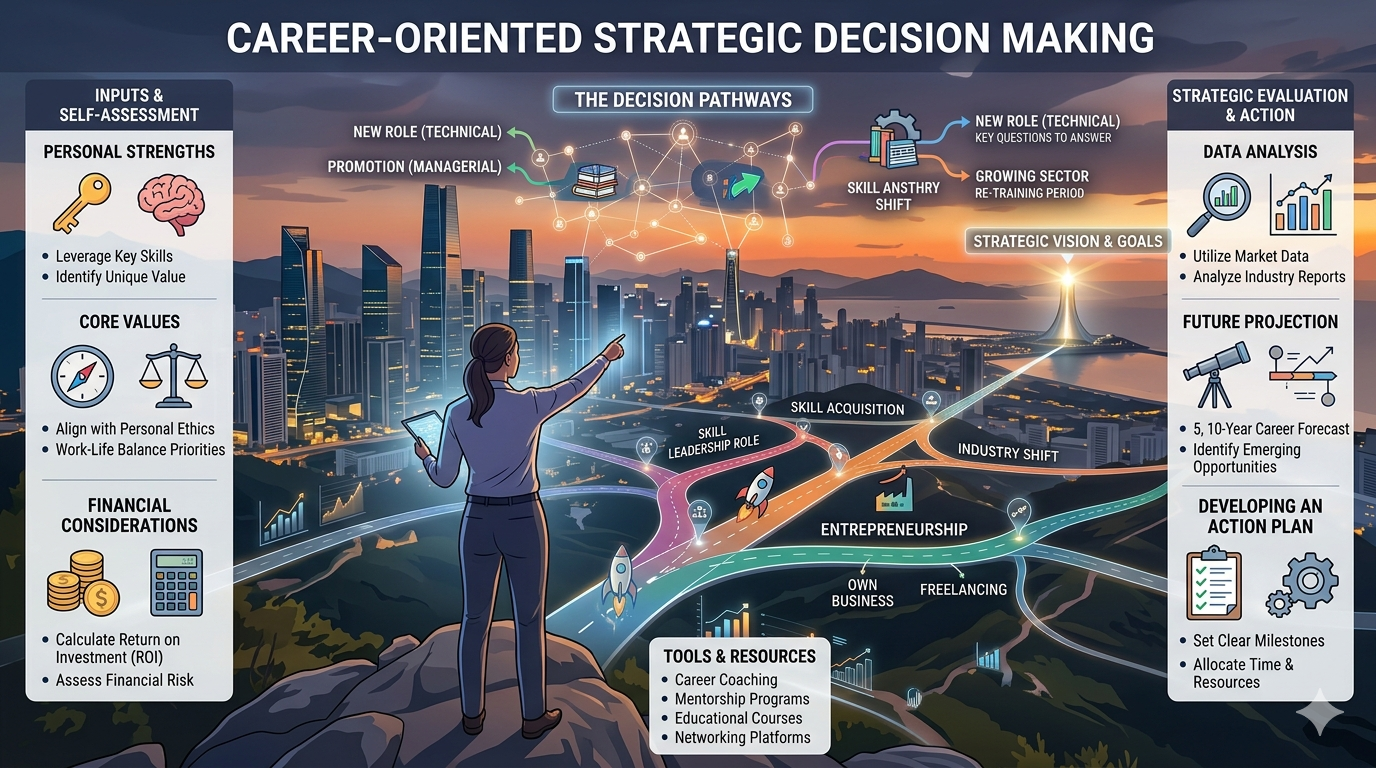
Diagram displaying stages of a structured decision-making process
Disclaimer
This article is for general informational and educational purposes only. It does not constitute professional psychological, counseling, medical, or consumer purchasing advice. References to programs, books, tools, or methods do not imply endorsement or guarantee of results. Readers are encouraged to consult licensed professionals and verified educational sources when pursuing personal development.