
Machiavellianism in Social Dynamics: An Academic and Ethical Overview
Understanding interpretations in philosophy and psychology without prescriptive application
Machiavellianism often appears in discussions about social behavior, leadership, and interpersonal dynamics. In academic contexts, scholars link it to ideas from Niccolò Machiavelli’s writings and to a personality trait examined in psychology. This article explores how researchers and theorists interpret Machiavellianism in social dynamics, with attention to historical context and empirical research. Overall, the discussion remains descriptive and does not endorse any specific behaviors.
Who Was Niccolò Machiavelli?
Niccolò Machiavelli served as a political thinker in Renaissance Florence. His work in diplomacy and governance influenced his analysis of political systems. Most notably, The Prince presents observations about leadership and statecraft during periods of instability.
Importantly, scholars examine his writings within their historical setting. As a result, they do not treat his work as guidance for modern interpersonal behavior.
What Does “Machiavellianism” Mean?
The meaning of Machiavellianism varies across disciplines. In general, it refers to different concepts depending on context:
- In political philosophy, it describes realism and pragmatic analysis of power
- In psychology, it identifies a personality trait linked to patterns of thinking and interaction
- In social discussions, it refers to interpretations of complex interpersonal behavior
Overall, academic usage remains descriptive. Therefore, it avoids prescribing how individuals should behave.
Machiavellianism in Political Philosophy
In political theory, many scholars interpret Machiavelli’s ideas as an early form of realism. His writings analyze how leaders respond to uncertainty, conflict, and shifting alliances.
However, these discussions focus primarily on governance and institutional stability. Consequently, applying political theory directly to everyday relationships is often viewed as an oversimplification in academic fields.
Interpreting Machiavellianism in Social Dynamics
Within social science literature, researchers examine Machiavellianism as part of broader studies on human interaction. They analyze how individuals navigate group settings, communication, and decision-making.
For example, research may explore:
- How people interpret social situations
- Variations in communication styles
- Differences between long-term and short-term thinking
These observations aim to describe behavior patterns. At the same time, they do not guide or justify actions. Moreover, academic discussions emphasize that multiple factors—such as culture, ethics, and personal values—shape human interaction.
Modern Psychology: Machiavellian Traits
In psychology, Machiavellianism forms part of the Dark Triad, alongside narcissism and psychopathy. Researchers study it using standardized assessments and structured research frameworks.
Typically, findings describe:
- Tendencies related to strategic thinking
- Patterns in interpersonal perception
- Variability in responses to social environments
Researchers present these findings cautiously. In addition, they avoid labeling traits as inherently positive or negative. Instead, context plays a central role in interpretation.
Machiavellianism in Organizations (Neutral Context)
In organizational behavior studies, scholars analyze Machiavellianism in relation to workplace interactions and leadership frameworks. They examine how different personality traits relate to structured environments.
Specifically, studies may consider:
- Team dynamics
- Communication approaches
- Organizational outcomes
These discussions remain analytical. Furthermore, they do not serve as guidance for workplace conduct or interpersonal strategy.
Ethical Debates and Criticisms
Scholars frequently debate Machiavellianism within ethics and philosophy. These debates often highlight several concerns.
For instance, researchers note:
- Tension between pragmatic decision-making and moral responsibility
- Risks of interpreting descriptive theories as behavioral justification
- Broader implications for trust and social cohesion
Consequently, these discussions emphasize careful ethical reflection when examining theories related to power and behavior.
Why Machiavellianism Is Often Misunderstood in Social Contexts
In everyday language, people often use the term “Machiavellian” to describe behavior perceived as calculating or strategic. However, this usage can oversimplify complex academic ideas.
In contrast, academic contexts provide more nuance:
- Scholars ground the concept in historical analysis
- Researchers study psychological traits through empirical methods
- Interpretations vary across disciplines
Therefore, simplified interpretations may overlook the depth of both Machiavelli’s writings and modern research.
Context & Educational Framing
In political philosophy literature, scholars analyze Machiavelli’s work within the context of Renaissance governance. Meanwhile, psychological research treats Machiavellianism as a personality construct used to examine behavior patterns.
In discussions of social dynamics, researchers use the concept as an analytical lens rather than a behavioral model. Accordingly, they do not present it as an approach to relationships or communication.
This article does not endorse Machiavellianism in social settings. Instead, it highlights the importance of ethical consideration, critical thinking, and responsible interpretation of academic concepts.
FAQ
What is Machiavellianism in social dynamics?
It refers to how scholars discuss the concept in relation to interpersonal behavior and group interaction. In academic contexts, it remains descriptive rather than prescriptive.
Is Machiavellianism a recommended social approach?
No. Academic research presents it as a subject of study, not as advice or a behavioral model.
Why is Machiavellianism linked to psychology?
Researchers study it as a personality trait within frameworks such as the Dark Triad to better understand patterns in human behavior.
Trusted Sources
- Peer-reviewed journals in social and personality psychology
- Academic texts on political philosophy and Renaissance history
- University research on organizational behavior
- Recognized encyclopedias and scholarly publications
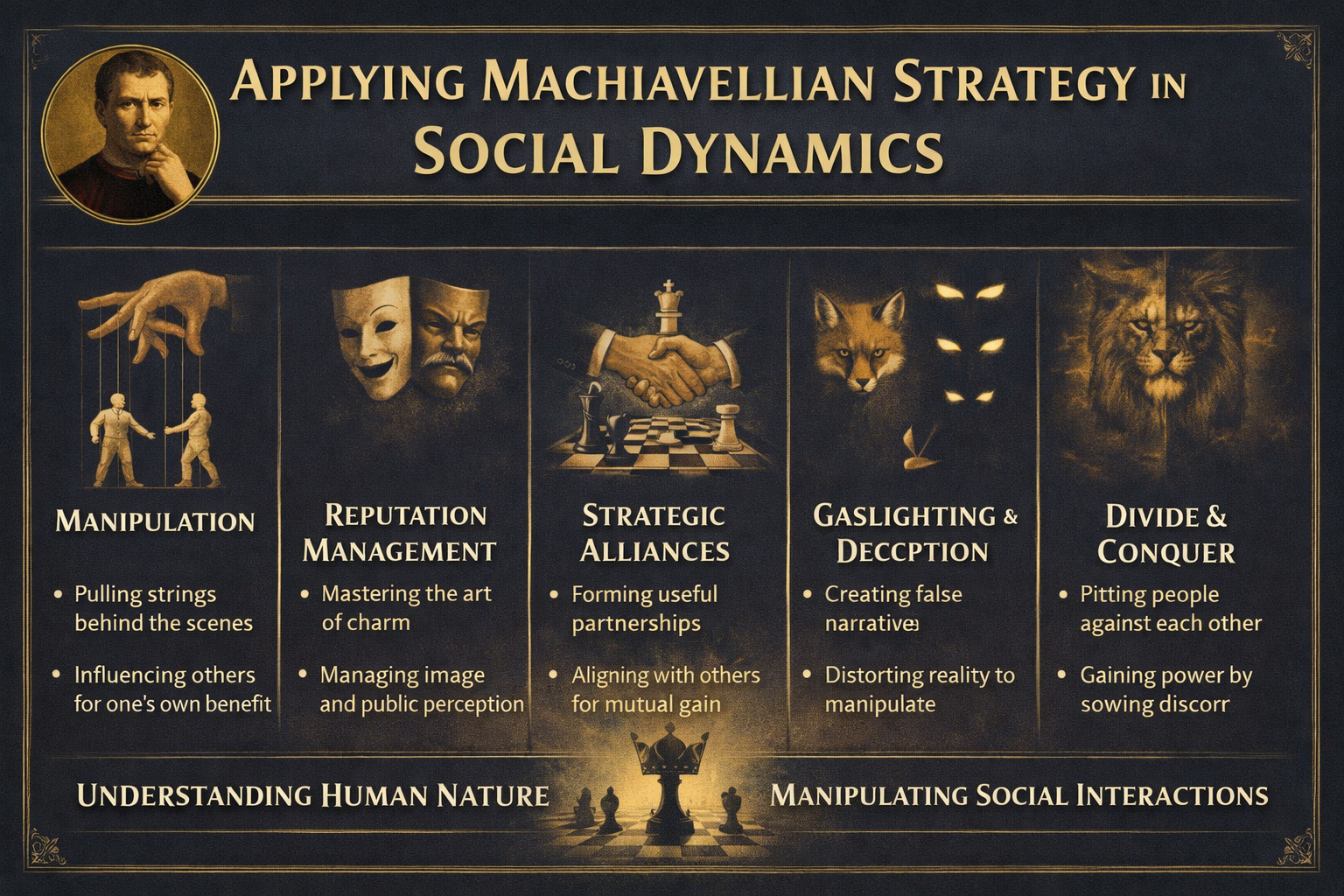
Visual summary of concepts associated with Machiavellianism across disciplines
Disclaimer
This article is for general informational and educational purposes only. It does not constitute psychological, legal, political, or interpersonal advice. References to historical figures, leadership theories, or psychological traits do not imply endorsement, instruction, or guarantee of outcomes. Readers are encouraged to consult verified academic sources and licensed professionals when interpreting psychological research.