by iamrolanddiaz | Feb 16, 2026 | Awareness, Suppliment, Vitamins
A neutral comparison of ingredient composition, formulation type, labeling focus, and product format
This comparison-focused article examines two barley-based supplement products offered by Ascendra International: Best Barley and Barley Fusion. The content highlights factual differences in ingredient composition, formulation structure, labeling disclosures, packaging format, and general product positioning. The purpose is to support consumer awareness by outlining observable distinctions without implying health benefits, effectiveness, or purchasing preference.
1. Ingredient Composition Comparison (Label-Based)
| Product |
Primary Ingredient |
Additional Listed Ingredients |
Ingredient Scope |
| Best Barley |
Barley grass (green barley) |
Typically positioned as single-ingredient |
Narrow (barley-focused) |
| Barley Fusion |
Barley (organic Australian barley) |
Additional ingredients such as fenugreek, glutathione, collagen (as listed) |
Broader (multi-ingredient blend) |
Comparison note:
Best Barley is commonly described as a barley-focused product made from green barley grass, while Barley Fusion is positioned as a blended formulation containing barley plus additional functional or nutritional components. Ingredient complexity reflects formulation design rather than verified product performance.
2. Formulation and Product Format
| Product |
Common Form |
Packaging Type |
Format Characteristics |
| Best Barley |
Powdered drink mix |
Packaged product (container or sachets, depending on listing) |
Plain barley-based powder |
| Barley Fusion |
Powdered drink mix |
Sachets or portioned packs |
Blend-style beverage powder |
Both products are marketed as powdered drink formulations. Barley Fusion is typically presented as a multi-ingredient drink mix, while Best Barley is positioned as a simpler barley-based powder.
3. Ingredient Complexity and Blend Structure
| Comparison Factor |
Best Barley |
Barley Fusion |
| Number of ingredients |
Fewer |
Multiple |
| Botanical components |
Primarily barley grass |
Barley plus additional plant-based ingredients |
| Added non-plant compounds |
Typically none |
Includes compounds such as collagen or glutathione (label-dependent) |
| Flavor or blend positioning |
Minimal or plain |
Blended or flavored formulation |
Ingredient complexity reflects formulation strategy and labeling disclosure rather than suitability or health-related outcomes.
4. Product Positioning
| Product |
Publicly Described Positioning |
Positioning Focus |
| Best Barley |
Barley-based nutritional supplement |
Simpler, barley-centered formulation |
| Barley Fusion |
Multi-ingredient wellness drink blend |
Combined ingredients in a single mix |
These descriptions reflect branding and product presentation rather than scientific validation or performance claims.
5. Packaging, Convenience, and Preparation Comparison
| Feature |
Best Barley |
Barley Fusion |
| Packaging format |
Container or sachets |
Sachets or portioned packs |
| Portability |
Moderate |
High (single-serve sachets) |
| Preparation style |
Mixing with liquid |
Mixing with liquid |
| Storage considerations |
Dry, sealed container |
Dry, sealed sachets |
6. Cost Range Awareness
| Product |
Observed Price Point (PHP) |
Price Influenced By |
| Best Barley |
Around ₱1,150 MSRP |
Ingredient simplicity, packaging, brand positioning |
| Barley Fusion |
Typically higher than Best Barley |
Multi-ingredient formulation, sachet format, branding |
Price differences reflect formulation complexity, packaging design, and market positioning rather than verified quality or effectiveness.
7. Label Transparency and Regulatory Awareness
| Comparison Element |
Best Barley |
Barley Fusion |
| Ingredient disclosure |
Lists barley-based content |
Lists barley plus added ingredients |
| FDA Philippines registration |
If listed |
If listed |
| Batch/expiry labeling |
Manufacturer-dependent |
Manufacturer-dependent |
| Marketing language |
General product positioning |
Blend or multi-ingredient positioning |
FDA registration status, if present, indicates regulatory listing rather than health effectiveness or product ranking.
8. General Safety and Consumer Awareness Considerations
| Consideration |
Relevance |
| Ingredient list review |
Helps identify allergens or additives |
| Multi-ingredient awareness |
Important for consumers sensitive to certain components |
| Authenticity verification |
Supports counterfeit risk reduction |
| Marketing claim evaluation |
Encourages reliance on verifiable label information |
| Storage and expiry checks |
Supports label accuracy over time |
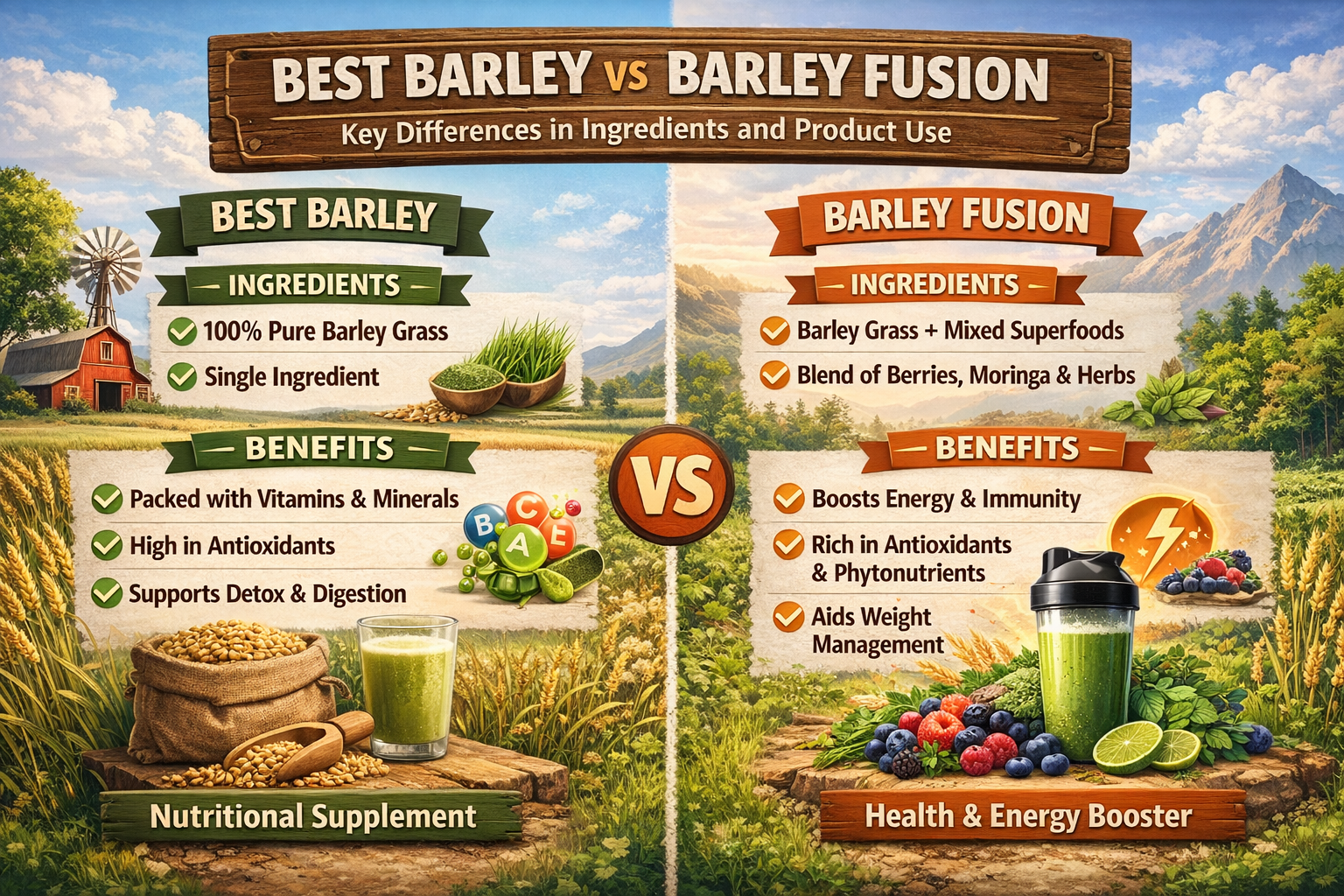
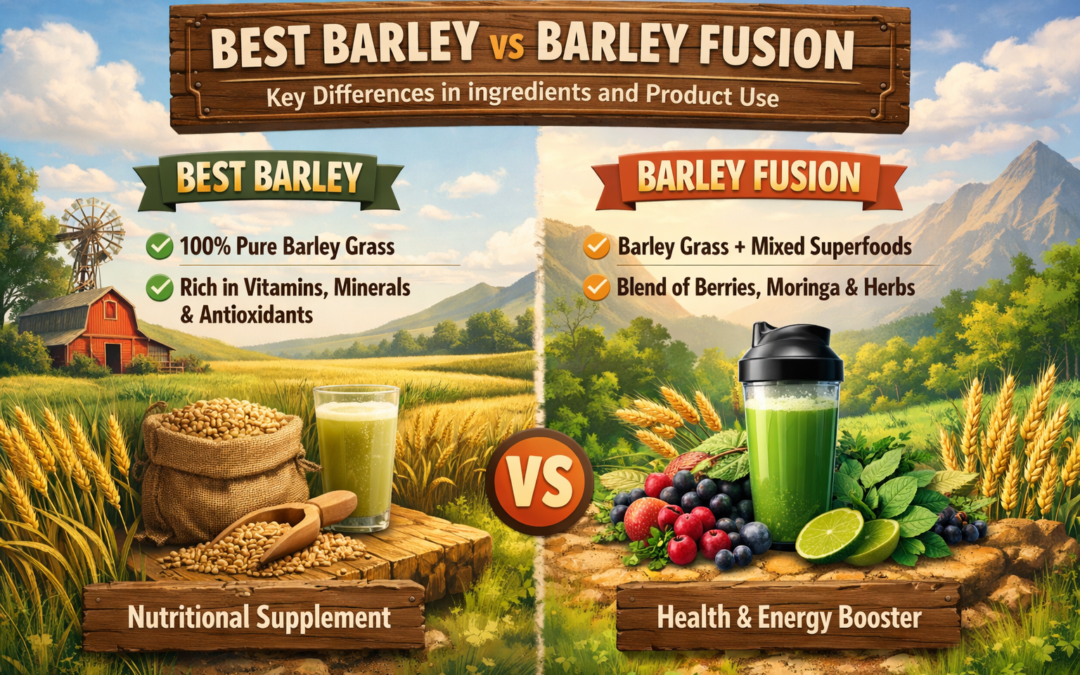
Infographic presenting ingredient groupings and product format differences in a visual comparison layout.
Neutral Comparison Background
In supplement labeling standards, single-ingredient products often emphasize botanical purity and simplicity, while blended products highlight a broader range of components. In FDA Philippines registration and inspection processes, listing status indicates regulatory documentation rather than verified health outcomes. In consumer verification practices, ingredient transparency, batch codes, expiry labeling, and packaging integrity are commonly reviewed to confirm authenticity and product traceability.
FAQ
What is the main ingredient difference between Best Barley and Barley Fusion?
Best Barley is typically described as a barley-focused product made from green barley grass, while Barley Fusion includes barley along with additional listed ingredients such as plant extracts or compounds.
How do their formulations differ?
Both products are commonly available as powdered drink mixes, but Barley Fusion is positioned as a multi-ingredient blend, whereas Best Barley is positioned as a simpler formulation.
Does a higher price indicate better product performance?
Price reflects factors such as formulation complexity, packaging, sourcing, and branding, not guaranteed effectiveness or health-related outcomes.
Trusted Sources
FDA Philippines — Food Supplement Registration Database
Department of Health (DOH) Philippines — Nutrition Guidance
World Health Organization (WHO) — Supplement Safety Resources
Philippine Consumer Act (RA 7394)
Publicly available product label information from Ascendra International
Disclaimer
This content is provided for general informational and factual comparison purposes only. It does not constitute medical, nutritional, or consumer purchasing advice. Mentions of vitamins, supplements, nutrients, or brands do not imply endorsement, effectiveness, or guaranteed health outcomes. Individuals should consult qualified healthcare professionals and official regulatory sources when making supplement-related decisions.
by iamrolanddiaz | Feb 12, 2026 | Suppliment, Vitamins
Community Observations on Routines, Packaging, and Product Accessibility
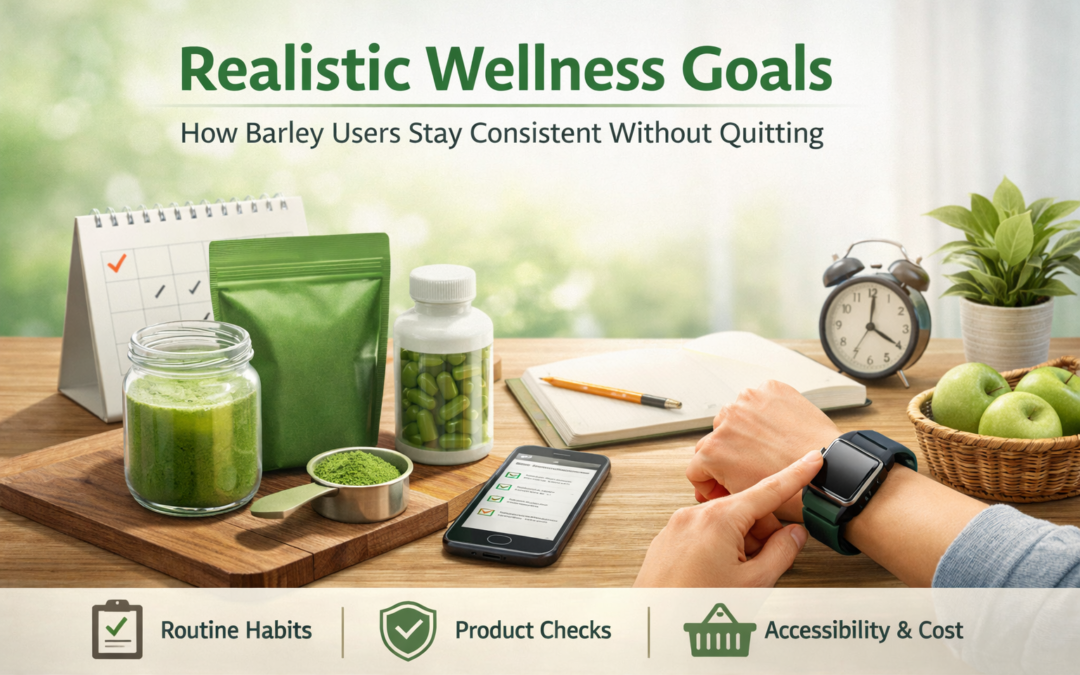
This article documents factual experiences from individuals who have incorporated barley-based wellness products into their routines. Observations focus on post-purchase aspects such as packaging usability, storage, accessibility, and adherence strategies without making claims about health benefits or outcomes. The goal is to provide educational insights into how product design and personal habits can support consistent use from a practical standpoint.
Advocacy / Review
-
Some users have noted that single-serve packets or pre-measured portions make it easier to maintain a consistent routine, compared to bulk containers.
-
Packaging integrity, such as resealable pouches or sturdy containers, was commonly observed as a factor in preventing product degradation and supporting storage convenience.
-
Observations from community members highlight that keeping products in visible, accessible areas helps reinforce consistency without relying on reminders or schedules.
-
Users have compared different forms of barley products (powder vs. capsules) in terms of ease of handling, preparation time, and portability, noting neutral differences without linking to health outcomes.
-
Cost and availability observations were also shared, showing that accessible pricing and local stock availability may influence continued use, without implying necessity or effectiveness.
-
Several users mentioned hypothetical strategies such as tracking daily intake or pairing with habitual routines to maintain consistency. These are described as neutral organizational habits rather than health guidance.
Context Section
In consumer product regulation and awareness, documenting user experiences post-purchase helps build knowledge about product handling, packaging integrity, and adherence patterns. FDA registration checks and label verification can further ensure authenticity and regulatory compliance. Learning from practical user observations provides educational awareness for those evaluating their own routine consistency strategies.
FAQ
Q1: How can consumers verify barley product authenticity after purchase?
A1: Checking for FDA registration numbers, batch codes, and clear labeling can provide assurance of authenticity. Consumers may also reference publicly available regulatory databases for verification.
Q2: What differences exist between powdered and capsule barley products from a usage perspective?
A2: Powdered products may require preparation or mixing, while capsules offer convenience in portability and storage. Observations focus on handling and accessibility rather than health outcomes.
Q3: What post-purchase factors affect consistency in use?
A3: Neutral factors include packaging design, storage ease, product accessibility, and user routine organization. These help individuals maintain habits without implying benefits or health results.
Trusted Sources:
-
FDA Philippines product registration guidelines
-
Department of Health (DOH) general nutrition advisories
-
WHO guidelines on dietary supplement safety
-
Academic publications on consumer product handling and user behavior
Disclaimer:
This content is provided for general informational and post-purchase awareness purposes only. It does not constitute medical, nutritional, or consumer purchasing advice. Mentions of barley products do not imply endorsement, effectiveness, or guaranteed health outcomes. Individuals should consult qualified healthcare professionals and official regulatory sources for health-related decisions.
by iamrolanddiaz | Feb 12, 2026 | Suppliment, Vitamins
This FAQ is designed to help consumers evaluate how barley-based supplement or nutrition products may be used responsibly as part of a daily routine. It focuses on label reading, safety checks, preparation considerations, and habit-building strategies based on general consumer safety practices. This is not medical advice and does not guarantee health outcomes.
Best Barley FAQ
1) What is “Best Barley” usually marketed as?
“Best Barley” is commonly presented as a barley-based food supplement or nutrition product, often sold in powdered form. Packaging typically highlights barley content, plant-based nutrients, and general wellness positioning. Consumers should rely on label information and regulatory verification, not marketing claims.
2) How can I take Best Barley safely without relying on marketing claims?
A safer approach is to follow basic consumer verification steps:
-
Check if the product is FDA-registered (if applicable for its category)
-
Confirm the label has a complete ingredient list
-
Review manufacturer details and contact information
-
Check for batch/lot number and expiration date
-
Avoid products with exaggerated health claims
This helps reduce risk from counterfeit, mislabeled, or non-compliant products.
3) What label details should I check before using it daily?
Before building a routine, check whether the packaging includes:
-
Complete ingredient list (not “proprietary blend” only)
-
Net content/weight and serving format
-
Manufacturer/importer/distributor information
-
Storage instructions
-
FDA notification/registration number (if provided)
-
Expiration date and lot/batch code
A complete label generally indicates better transparency and accountability.
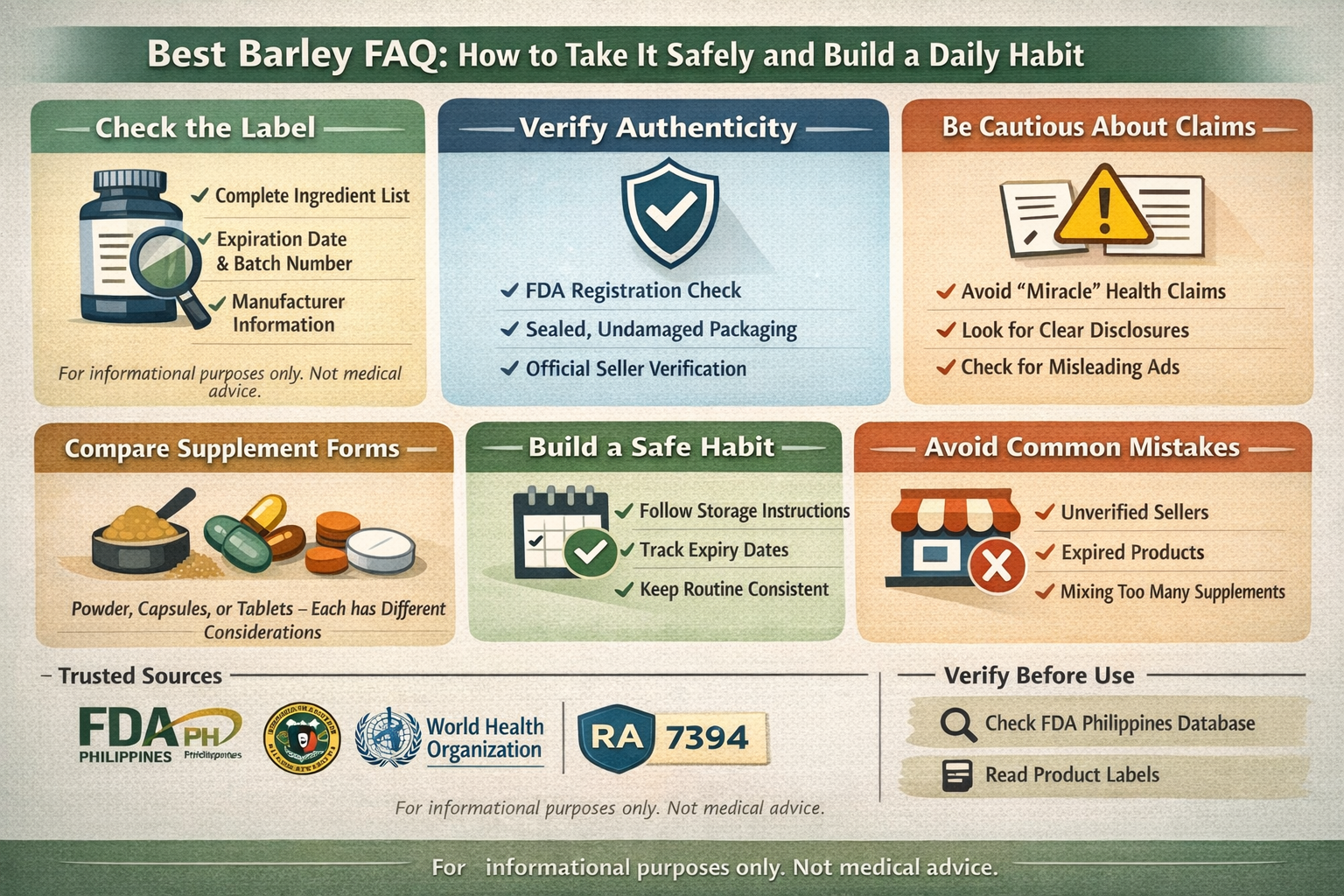
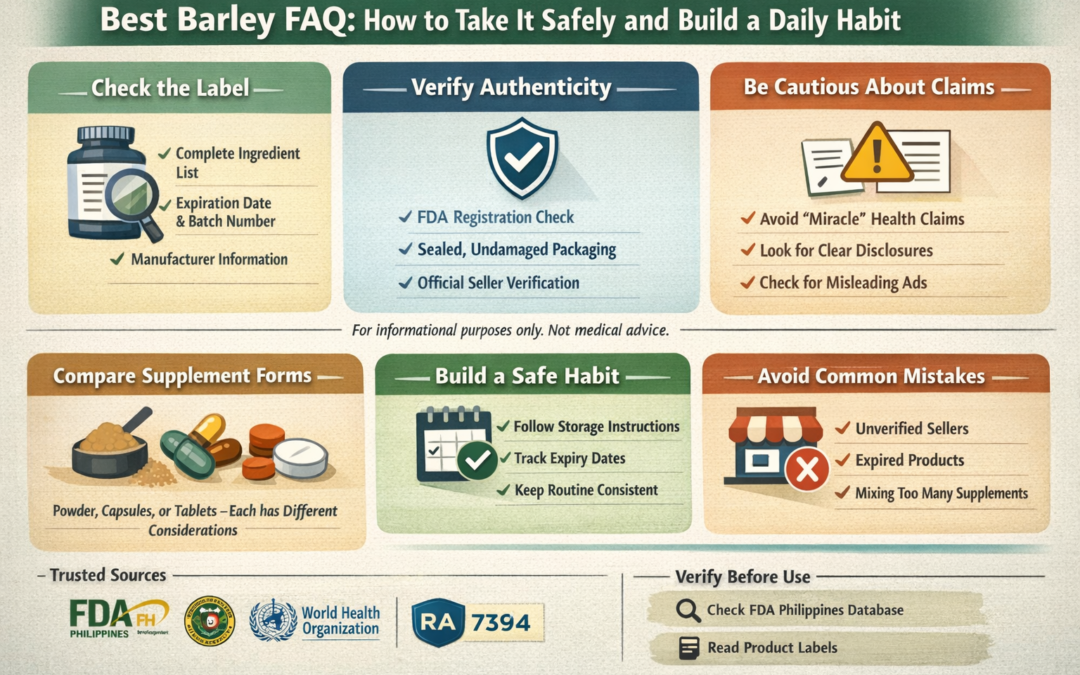
Infographic showing verification, labeling, and daily use routine tips for Best Barley products.
4) Are there risks in taking barley-based supplements every day?
Daily use may carry risks depending on the product formulation, quality control, and consumer sensitivities. Potential concerns may include:
-
Ingredient intolerance or allergies
-
Contamination risk from low-quality production
-
Misleading labeling or incomplete disclosure
-
Overlapping intake if the consumer uses multiple supplements
For safety, consumers should treat supplements as optional products and prioritize verified labeling and regulatory compliance.
5) What is the safest way to confirm authenticity before using it?
Consumers can reduce counterfeit risk by checking:
-
Seller legitimacy (official store, authorized distributor listing)
-
Packaging seal and tamper-evident features
-
Batch code consistency and print quality
-
Matching product name and manufacturer details across platforms
-
FDA advisories (if the product has warnings or alerts)
If packaging appears inconsistent or poorly printed, it may be safer not to use it.
6) Is powder form safer than capsules or tablets?
Not necessarily. Powder, capsules, and tablets each have different consumer considerations:
-
Powder: easier to mix, but depends heavily on storage and moisture protection
-
Capsules: more controlled portion format, but harder to inspect contents
-
Tablets: stable form, but may contain binders/coatings that some consumers prefer to avoid
The safest option is usually the one with clear labeling, strong packaging integrity, and verified sourcing, not the form itself.
7) How do I build a daily habit without overdoing it?
A safer habit-building approach focuses on consistency and compliance, not increasing frequency or amounts.
Helpful consumer habit strategies include:
-
Linking it to an existing routine (breakfast preparation, meal planning)
-
Storing it properly in a dry, clean place (based on label instructions)
-
Keeping a simple checklist to track product usage and expiration dates
-
Avoiding mixing too many new supplements at the same time
This reduces confusion and improves routine consistency without turning it into a dependency.
8) What mistakes do consumers commonly make when starting barley supplements?
Common consumer mistakes include:
-
Buying from unofficial sellers with unclear sourcing
-
Ignoring expiration dates and batch information
-
Using multiple similar supplements without tracking ingredients
-
Trusting social media claims over label verification
-
Assuming “natural” automatically means “risk-free”
A conversion-safe decision should always prioritize transparency and product legitimacy.
9) Can I mix Best Barley with other supplements or drinks?
Some consumers mix supplement powders with beverages for convenience, but safety depends on:
If the label does not clearly describe preparation compatibility, it may be safer to keep usage simple and consistent.
10) What is a “safe daily routine checklist” before continuing long-term use?
A conversion-stage checklist may include:
- ✅ Verified supplier or official distributor
- ✅ Packaging is sealed and not damaged
- ✅ Complete ingredient list is visible
- ✅ Expiration date is valid
- ✅ Batch/lot number is readable
- ✅ Storage instructions are followed
- ✅ No exaggerated health claims on packaging
- ✅ Consumer is not relying on the product as a medical substitute
This checklist supports safer decision-making without implying medical outcomes.
Context: Why Verification Matters in Supplements
In supplement evaluation, the biggest consumer risks usually come from:
-
counterfeit products
-
incomplete labeling
-
misleading marketing claims
-
poor storage and repackaging
-
lack of regulatory documentation
For conversion-stage buyers, the safest approach is to treat supplements as optional consumer products and focus on traceability, labeling transparency, and regulatory compliance.
Quick FAQ
How can I verify if Best Barley is FDA-registered in the Philippines?
Consumers can check the FDA Philippines verification portals or official advisories using the product name, manufacturer, and registration details if provided on the label.
What’s more important: price or labeling transparency?
Label transparency and verifiable sourcing are typically stronger safety indicators than price alone.
What is the biggest red flag when buying barley supplements online?
The biggest red flag is when the product lacks clear manufacturer information, batch codes, and has exaggerated health claims.
Trusted Sources (Official / Educational)
-
FDA Philippines (Product verification tools and advisories)
-
Department of Health (DOH) consumer health guidance
-
WHO supplement safety references
-
Consumer Act of the Philippines (RA 7394)
Disclaimer
This content is provided for general informational and safe decision-support purposes only. It does not constitute medical, nutritional, or consumer purchasing advice. Mentions of vitamins, supplements, nutrients, or brands do not imply endorsement, effectiveness, or guaranteed health outcomes. Individuals should consult qualified healthcare professionals and official regulatory sources when making supplement-related decisions.
by iamrolanddiaz | Feb 12, 2026 | Suppliment, Vitamins
This comparison outlines neutral, factual differences between two barley-based supplement/drink products that appear in publicly accessible product descriptions. It focuses on ingredients, formulation type, and packaging distinctions to support consumer awareness and factual understanding — without recommending, ranking, or implying health outcomes.
Product Identity
| Feature |
Best Barley |
Barley Fusion |
| Typical Form |
Powder drink mix (barley-based) |
Powder drink mix (barley blended with additional actives) |
| Source / Positioning |
Described as pure organic barley from Australian farmlands in a sachet form (per media) |
Described as a multi-ingredient barley blend with added fenugreek, glutathione, and hydrolyzed collagen (per manufacturer) |
| Packaging |
Sachet format |
Sachet format |
| Indicated Style |
Single-ingredient barley product |
Multi-component barley fusion product |
Ingredients Comparison
Best Barley
Barley Fusion
-
Barley (young, quality barley)
-
Fenugreek (herb)
-
Glutathione (a compound often found in skin-care and wellness blends)
-
Hydrolyzed collagen (protein fragment)
Formulation and Product Type
Best Barley
Barley Fusion
-
A blend combining barley with additional actives (fenugreek, glutathione, collagen) within each sachet.
-
A multi-ingredient formulation rather than a pure barley powder.
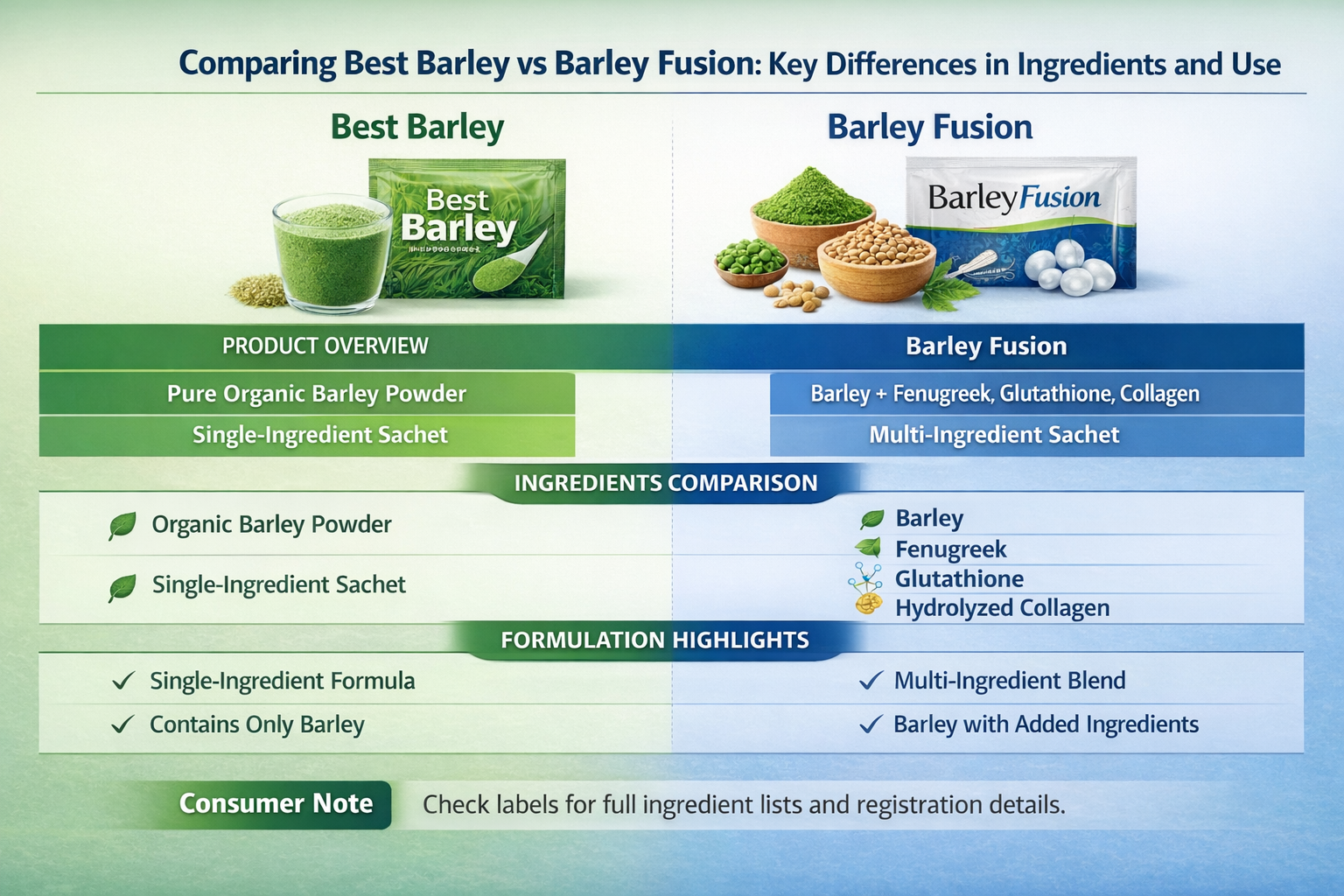
Infographic shows comparative ingredient lists of two barley-based products.
Packaging, Label, and Registration Notes
-
Both products are described in sachet formats but have different ingredient scopes — one is predominantly barley; the other is a blend of barley plus added components.
-
There is no publicly available Philippine FDA registration data in the sources reviewed for either product. Consumers can check official FDA Philippines records or the physical label for batch registration numbers and compliance marks.
Context: Barley Ingredient Overview
In general nutritional science and ingredient documentation:
-
Barley itself is a cereal grain providing dietary fiber, carbohydrates, and a range of micronutrients depending on processing and form.
-
Product formulations can vary substantially based on added ingredients (e.g., herbs, amino acids, powders like collagen or glutathione), which affect ingredient lists and intended use formats.
Hypothetical Use Scenarios
-
A consumer comparing a single-ingredient barley powder product with a multi-ingredient barley blend might observe that the two have distinct ingredient lists and product formulations.
-
Evaluating the label ingredient list is one factual method to distinguish between a product with one main source versus one with multiple added components.
FAQ
What’s the main ingredient difference?
Best Barley is described as primarily organic barley powder, while Barley Fusion contains barley plus additional components like fenugreek, glutathione, and collagen.
How do the product formats differ?
Both are sachet-based powder products, but the ingredient complexity differs — one is a simple barley powder, and the other is a blended formulation.
What should consumers check on labels?
Consumers can review the full ingredient list, serving size, and any regulatory registration numbers on the packaging to verify contents and compliance.
Trusted Source Notes
Mandatory Disclaimer
This content is provided for general informational and factual comparison purposes only. It does not constitute medical, nutritional, or consumer purchasing advice. Mentions of business names, products, or ingredients do not imply endorsement, effectiveness, or guaranteed outcomes. Individuals should consult qualified healthcare professionals and official regulatory sources when making supplement-related decisions.
by iamrolanddiaz | Feb 12, 2026 | Suppliment, Vitamins
A neutral, decision‑focused overview of label, formulation, and quality factors for barley‑based beverages
This article helps readers understand key factors to consider when evaluating barley drink products across different brands. Barley drinks vary in formulation, ingredient lists, nutrient content, and processing methods; assessing these elements can support informed consumer decisions. The discussion below focuses on product characteristics, label transparency, compliance with regulatory standards, and considerations relevant to product quality — without making health claims, prescribing usage, or promoting specific brands.
Understanding Barley Drink Types
Barley drinks appear in several forms, including ready‑to‑drink, powdered mixes, and brewed concentrates. Some products emphasize simple barley water (water infused with barley grain) while others include added flavors, sweeteners, or nutrients. In consumer decision‑making, it is useful to note how the composition differs across types: for example, whether a product is primarily barley extract in water or a multi‑ingredient beverage with additives.
Ingredient Lists and Transparency
Product labels should clearly list all ingredients, typically in descending order by weight. Common components may include barley extract or grain, water, flavorings (such as natural or artificial flavors), and sweeteners (such as sugar or non‑nutritive sweeteners). Understanding these entries helps distinguish between products with minimal ingredients and those with complex formulations. Be cautious when key inputs are not clearly described (e.g., unspecified “natural flavors”) as this can limit clarity about what the beverage contains.
Formulation Additives and Consumer Awareness
Barley‑based beverages sometimes include additives for texture, stability, or taste. These may be thickeners, preservatives, or colorants. In supplement quality evaluation, consumers can review the safety assessments or regulatory status of such additives on official food safety lists (e.g., allowable food additives under FDA Philippines food regulations). Awareness of additive names and functions can support decisions about product preferences without implying any health outcomes.
Packaging and Serving Formats
Barley drinks are sold in glass or plastic bottles, cartons, and single‑serve sachets for powdered products. Packaging influences convenience, storage, and labeling space for mandatory information like nutrition facts and ingredient lists. In label reading, ensure that serving size, storage instructions, and manufacturing details appear legibly.
Nutrition Information Panels
Most packaged beverages include a nutrition information panel. This panel outlines energy (calories) and amounts of macronutrients (e.g., carbohydrates) per serving size. While this content does not inform about health effects, it supports comparisons between products with differing sugar, carbohydrate, or other nutrient profiles. Consumers may consider how values differ across brands if nutrition content aligns with their personal dietary preferences.
Regulatory Compliance and Product Verification
In the Philippines, food and beverage products, including barley drinks, should be registered or notified as required under FDA Philippines rules. Checking whether a product has an FDA Philippines registration or listing number on its label can help verify it has undergone the standard administrative process. Consumers can consult official FDA Philippines databases or contact local regulatory offices for verification.
Hypothetical Evaluation Scenario
For example, a consumer comparing two barley drink products might observe that Product A lists barley extract, water, and sugar, while Product B lists barley water concentrate, natural flavors, and non‑nutritive sweeteners. In this hypothetical context, differences in ingredient complexity and sweetener types can be noted without asserting effects, suitability, or preference.
Context
In supplement and beverage quality evaluation, regulatory bodies such as FDA Philippines assess labeling compliance, ingredient safety, and product registration status. Food and beverage labeling regulations under the Consumer Act of the Philippines (RA 7394) require that products provide truthful and clear information to avoid misleading consumers. Clear labeling and transparent ingredient disclosure contribute to informed purchasing decisions. Official food safety guidance from WHO and regional standards can inform general safety considerations for ingredients and processing practices in barley‑based beverages.
FAQ
What should consumers look for on a barley drink label?
Consumers can check the ingredient list, nutrition information panel, manufacturer or distributor information, and any regulatory registration identifiers. Clear labeling supports comparison and understanding of product contents.
How can consumers verify that a barley drink meets Philippine regulatory standards?
Verification may involve checking if the product displays an FDA Philippines registration or listing number and reviewing official FDA databases or advisories related to food and beverage products.
What factors differentiate ready‑to‑drink barley beverages from powdered mixes?
Ready‑to‑drink products are pre‑formulated and packaged for immediate consumption, while powdered mixes require reconstitution. Differences may include formulation complexity, packaging type, and ingredient lists, which consumers can evaluate based on their preferences.
Trusted Sources
-
FDA Philippines — official food and beverage product registration and labeling requirements
-
Department of Health (DOH) — nutrition policy and food safety guidance
-
Consumer Act of the Philippines (RA 7394) — product labeling and consumer protection standards
-
World Health Organization (WHO) — general guidance on food safety and beverage formulation considerations
Disclaimer
This content is provided for general informational and decision‑consideration purposes only. It does not constitute medical, nutritional, or purchasing advice. Mentions of barley drinks or product characteristics do not imply endorsement, effectiveness, or guaranteed outcomes. Individuals should consult qualified professionals and official regulatory sources before making decisions related to product selection or use.
by iamrolanddiaz | Feb 12, 2026 | Suppliment, Vitamins
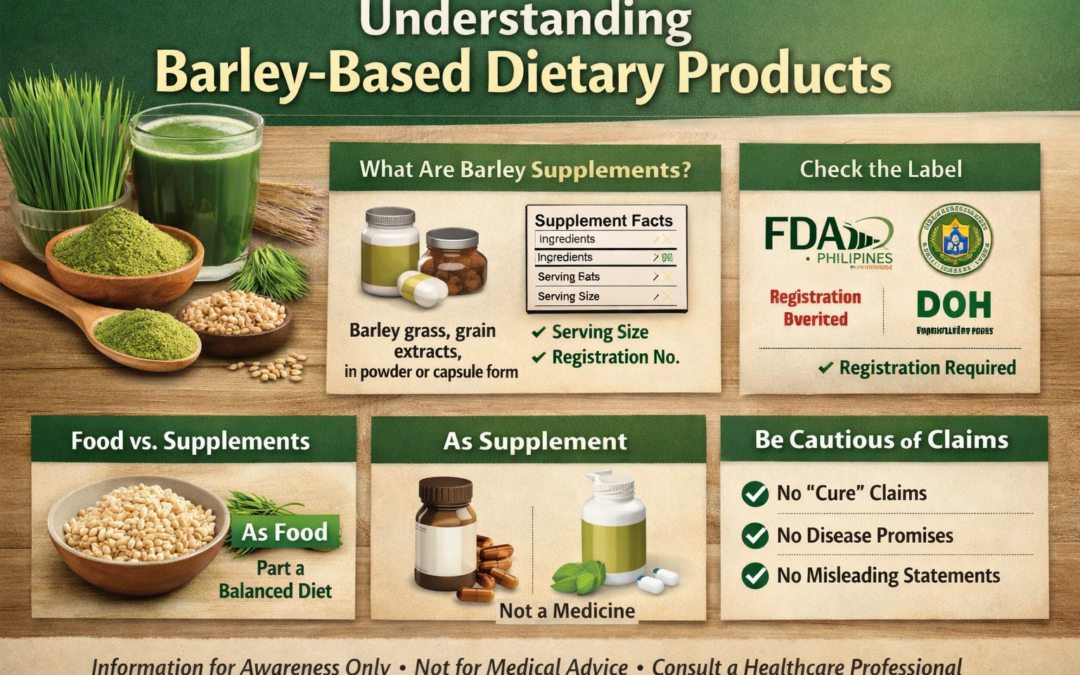
Barley is a cereal grain that, in nutrition science, is a source of carbohydrates and certain micronutrients when consumed as food. Some products marketed in the “supplements” category may include barley grass powder, barley juice powder, or barley grain extracts; these are typically presented as ingredients in powdered dietary products, capsules, or tablets.
What “Barley” Means in Dietary Products
-
In nutritional contexts, barley refers to parts of the barley plant (e.g., young barley grass) or barley grain.
-
When included in a product label, it is an ingredient name, not a medical claim.
-
Labels may list barley as a source of dietary fiber or plant matter — but not as a treatment or cure for any condition.
Philippine Regulatory Context
In the Philippines:
-
FDA Philippines requires that dietary supplement products be registered or notified before marketing, with accurate labeling that does not include false, misleading, or therapeutic claims.
-
Products must not be marketed as medicines or make disease‑related claims.
-
Labeling must list all ingredients and amounts per serving, instructions for use, warnings, and manufacturer/distributor information in compliance with applicable regulations.
How to Read Barley‑Product Labels
When reviewing a barley‑containing product label:
-
Check for ingredient list and serving size.
-
Look for lot or batch numbers and registration/notification identifiers if provided.
-
Note any disclaimer statements such as “This statement has not been evaluated by [a regulatory authority].”
-
Avoid any product label that suggests treating, preventing, or curing diseases.
General Awareness — Barley Nourishment vs. Supplements
In nutritional science:
-
Barley and barley grass are recognized as food ingredients, not drugs.
-
Barley as part of a balanced diet contributes carbohydrates and plant‑based components.
-
Products labeled as dietary supplements are treated differently from prescription or over‑the‑counter medicines under Philippine law.
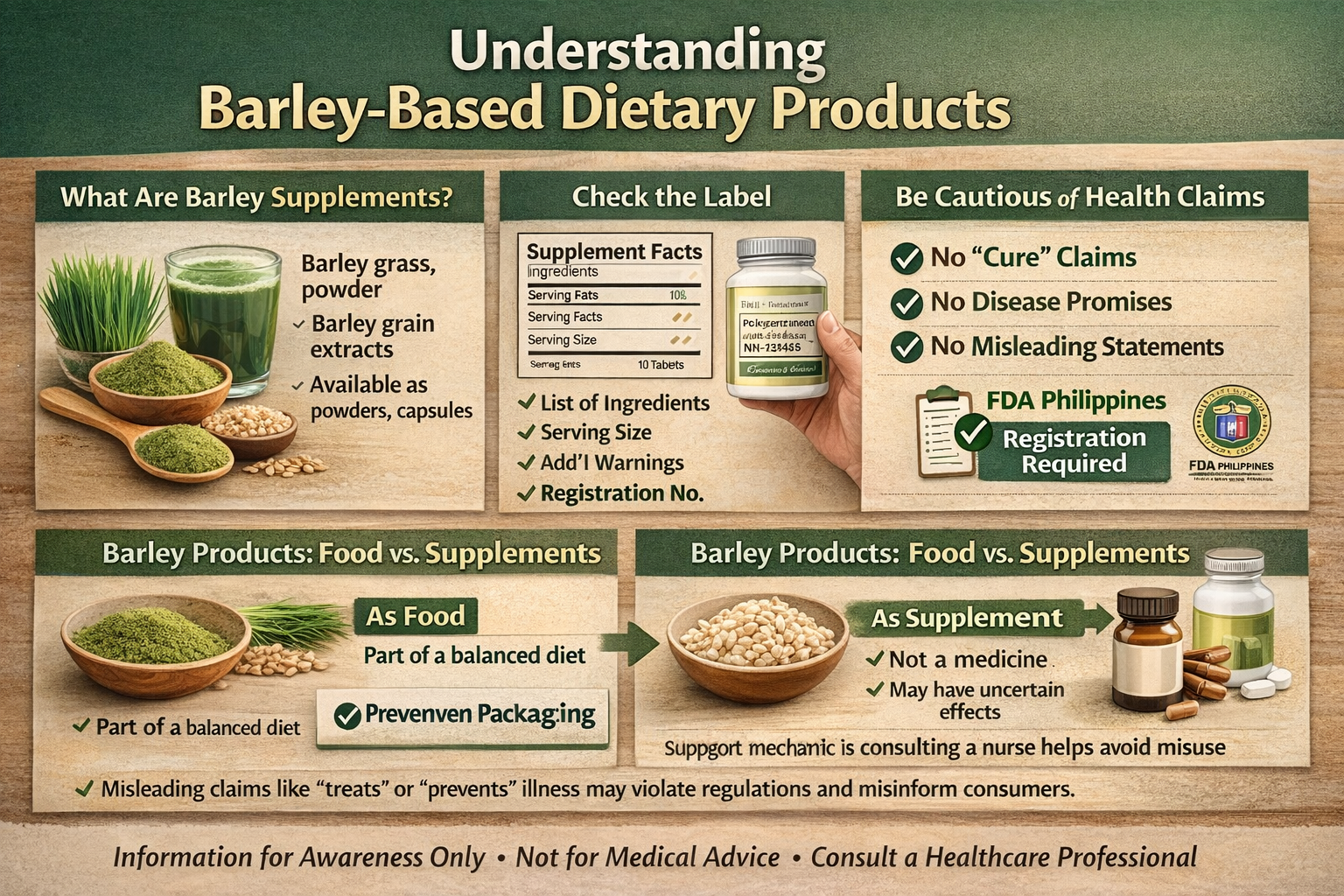
Infographic displaying barley-based dietary products, labeling, and consumer awareness points.
FAQ
What are barley‑based dietary products?
Barley‑based dietary products include powdered barley grass, barley grain components, or extracts that are marketed in forms like powders or capsules. They are considered food or dietary products, not medicines.
How are barley products regulated in the Philippines?
The FDA Philippines oversees the safety and labeling of dietary supplements and related products. Barley dietary products must comply with registration/notification requirements and must not make therapeutic claims.
What should I look for on a barley product label?
Look for a clear ingredient list, manufacturer/distributor information, serving size, and any regulatory identifiers. Avoid claims that imply disease treatment or prevention.
Trusted Sources
-
FDA Philippines (Food and Drug Administration, Republic of the Philippines) — regulatory oversight of food and supplements
-
DOH Philippines (Department of Health) — guidance on nutrition and consumer health
-
WHO Nutrition Guidance — general information on grains and dietary components
Disclaimer
This content is provided for general public awareness and educational purposes only. It does not constitute medical, nutritional, or consumer purchasing advice. Mentions of barley or any company’s products do not imply endorsement, effectiveness, or guaranteed health outcomes. Individuals are encouraged to consult qualified healthcare professionals and official regulatory sources when making health or supplement‑related decisions.