

Join at Ascendra International AI

Network Security Basics Every Marketer Should Know
An educational overview of fundamental network protection concepts for marketing professionals.
This article explains essential network security concepts that marketers should be aware of to protect digital assets and customer data. It covers general principles of cybersecurity relevant to marketing operations. The discussion refers to applicable Philippine regulations such as the Data Privacy Act of 2012 (RA 10173) and general compliance practices for digital tools. Readers will gain a factual understanding of security considerations without guidance on implementation or investment outcomes.
1. Understanding Network Security
Network security involves measures designed to protect the integrity, confidentiality, and availability of digital information and systems. For marketers, this includes safeguarding customer databases, marketing platforms, and internal communications.
2. Common Threats in Digital Marketing
Typical threats include phishing emails, malware, unauthorized access to CRM systems, and data breaches. Awareness of these risks helps organizations mitigate potential exposure.
3. Data Privacy Compliance
Under the Data Privacy Act of 2012, marketers handling personal data must obtain consent, limit data collection to lawful purposes, and implement safeguards. Breaches or mishandling can result in administrative or criminal penalties.
4. Secure Access Practices
Basic practices include strong password policies, two-factor authentication, and controlled access to digital platforms. While these measures support operational security, they do not constitute personalized security advice.
5. Ethical Considerations for Marketing Tools
Marketing platforms, email automation tools, and CRM systems should be evaluated for compliance with privacy laws and secure data handling standards. Ethical use includes limiting access to authorized personnel and avoiding unnecessary data retention.
Context Section (Neutral Background):
Under Philippine consumer protection principles, organizations must prioritize the security of client information. The National Privacy Commission (NPC) provides guidelines for businesses on secure data management. In general compliance practice, network security complements ethical marketing by reducing the risk of data leaks, service disruptions, or regulatory violations. Direct selling and digital marketing operations often involve cloud-based tools, which should be evaluated for security certifications and privacy compliance.
FAQ
Q1: What is network security in marketing?
A1: Network security refers to the practices and technologies used to protect digital systems and customer data used in marketing operations.
Q2: Which Philippine law governs data protection for marketers?
A2: The Data Privacy Act of 2012 (RA 10173) regulates the collection, processing, and storage of personal data in the Philippines.
Q3: What are common network security measures?
A3: Measures include secure passwords, two-factor authentication, encrypted communications, access controls, and secure management of marketing platforms.
Trusted Sources (Government / Official Only):
Data Privacy Act of 2012 (RA 10173) — National Privacy Commission
E-Commerce Act of 2000 (RA 8792) — Official Gazette of the Philippines
Department of Trade and Industry (DTI) — Official Website
Disclaimer:
This article is for general informational and educational purposes only. It does not constitute legal, financial, tax, or investment advice. References to network security practices or digital tools do not imply endorsement or recommendation. Readers should consult official government sources such as the NPC, DTI, or SEC for regulatory guidance.

How AI Is Transforming Network Marketing Strategies
A factual overview of common AI applications used in direct selling and referral-based business operations.

Setting SMART Goals for Network Marketing Activities in the New Year
A compliance-focused guide to planning measurable and realistic business tasks in direct selling and network-based distribution.
Setting goals at the start of the year is a common planning practice for individuals involved in network marketing and direct selling. This article explains how the SMART goal framework can be applied to network marketing-related activities in a structured and measurable way, while maintaining ethical communication and compliance with consumer protection expectations in the Philippines.
Network Marketing Industry Developments to Observe in 2026
An educational overview of structural shifts, regulatory focus areas, and technological adaptations in network marketing frameworks.
This article outlines observable developments and industry shifts that are becoming evident in the network marketing ecosystem as of 2026. It references relevant Philippine regulators such as the Department of Trade and Industry (DTI) and the Securities and Exchange Commission (SEC), as well as global consumer protection considerations. Readers will learn about structural and compliance-related trends without promotional or income-oriented framing.
1️⃣ Regulatory and Compliance Emphasis
In 2026, regulatory scrutiny on network marketing practices continues to focus on consumer protection. In the Philippines, the SEC monitors business models that involve compensation linked to enrollment and product distribution to identify potential pyramid schemes. The DTI enforces the Consumer Act of the Philippines (RA 7394) and E-Commerce Act (RA 8792) to protect buyers and users of digital platforms. Emphasis remains on transparency in compensation structures, clear product value, and appropriate disclosures.
2️⃣ Digital Tools and Data Privacy
Digital transformation persists as organizations adopt online platforms for product information, lead engagement, and customer service. Under the Data Privacy Act of 2012 (RA 10173), entities handling personal data must comply with lawful processing standards and secure consent. Informational systems such as customer relationship management (CRM) tools are increasingly discussed in neutral terms for operational coordination rather than as recruitment enablers.
3️⃣ Educational Content Standards
Aligned with global standards for expertise, experience, authoritativeness, and trustworthiness (EEAT), educational resources within network marketing contexts are being refined. This includes clear differentiation between product information and recruitment terminology, as well as accurate representation of roles and responsibilities without exaggerated claims.
4️⃣ Cross-Border Consumer Protection Awareness
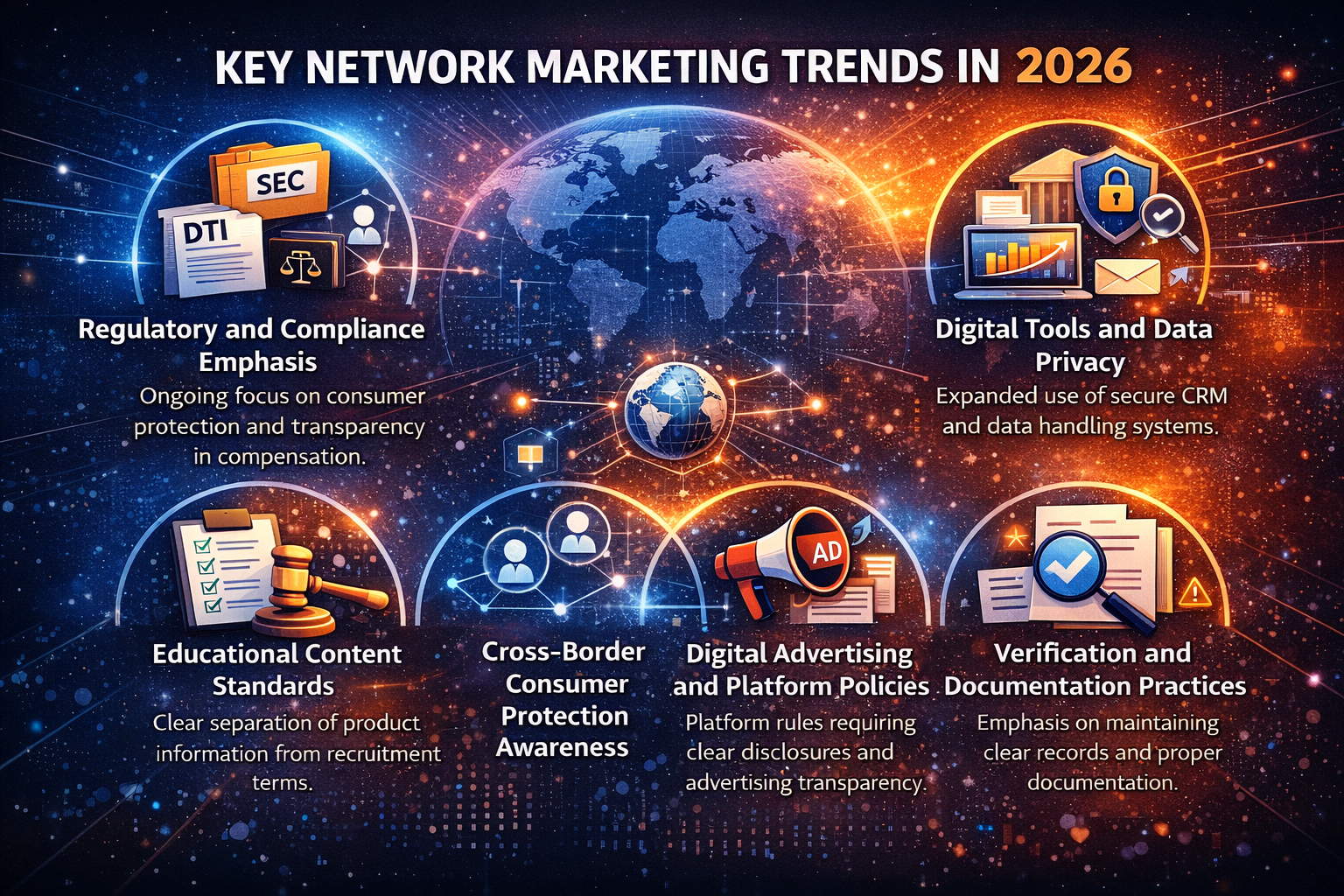
A structured visual summary of major network marketing trends observed in 2026.
Global consumer protection developments influence local practices, particularly when marketing activities span jurisdictions. Philippine regulators reference international norms when assessing disclaimers, digital contracts, and representations made through online channels. Entities engaging audiences internationally are encouraged to understand applicable export compliance, data transfer, and cross-border consumer rights frameworks.
5️⃣ Digital Advertising and Platform Policies
Platform-level policies — such as those of major search engines and social networks — increasingly require transparent disclosures and restrict misleading or unverified claims. Educational discussions in network marketing must align with these platform requirements to avoid removals or restrictions that could affect informational reach.
6️⃣ Verification and Documentation Practices
In operational terms, emphasis on documentation of product specifications, compensation plans, and training materials continues. Clear records support internal governance and facilitate response to regulatory inquiries. Educational standards for documentation also align with general business practice and risk management.
Under Philippine consumer protection principles, network marketing structures are subject to both general business registration requirements and specific scrutiny when compensation is linked to recruitment patterns. The SEC has issued advisories on what constitutes a pyramid scheme and highlights factors such as disproportionate enrollment rewards versus product-based compensation. Direct selling models typically involve product distribution through a network of independent sellers, and must prioritize verifiable product value over enrollment incentives to align with regulatory expectations.
Optional FAQ
Q1: What is the role of the SEC in network marketing in the Philippines?
The Securities and Exchange Commission evaluates business models to determine if compensation structures could be classified as pyramid arrangements under existing Philippine law.
Q2: How does the Data Privacy Act relate to digital tools in network marketing?
The Act governs the processing of personal data, requiring consent and lawful handling of information collected through digital platforms or databases.
Q3: What is direct selling?
Direct selling generally refers to the marketing and sale of products directly to consumers, where independent sellers earn compensation based on product sales value rather than recruitment.
Trusted Sources
-
Securities and Exchange Commission (SEC) Philippines advisory documentation
-
Department of Trade and Industry (DTI) Consumer Protection guidelines
-
Consumer Act of the Philippines (Republic Act No. 7394)
-
E-Commerce Act of 2000 (Republic Act No. 8792)
-
Data Privacy Act of 2012 (Republic Act No. 10173)
Disclaimer:
This article is for general informational and educational purposes only. It does not constitute legal, financial, tax, or investment advice. References to business models, structural developments, or industry practices do not imply endorsement or recommendation. Readers should consult official government sources such as the SEC and DTI for regulatory guidance.
- How Hot and Humid Weather Affects Daily Routines in the Philippines
 Hot and humid conditions are part of everyday life in the Philippines. This article explains how this climate commonly shapes daily routines, habits, and product choices, using neutral, educational, and location-specific context.
 - Understanding Skin Changes in Hot and Humid Climates
 An educational look at how warm, humid climates are commonly associated with skin texture and daily environmental context.
 - Everyday Hydration Awareness in Tropical Weather
 A neutral introduction to hydration awareness in tropical climates, focusing on daily context and general consumer understanding.
 - Why Daily Routines Shift During Hot Months
 An educational look at how warm and humid months in the Philippines are commonly linked to everyday routine adjustments.
 - How UV Exposure Is Commonly Discussed in the Philippines
 A neutral overview of how UV exposure is commonly described in Philippine climate discussions and public information sources.