
Spring-Inspired Nose Sculpting Trends
by Ramil Villar | Mar 21, 2026 | Aesthetic Trends
Spring-Inspired Nose Sculpting Trends: Educational Overview of Emerging Approaches
A seasonal look at evolving preferences in rhinoplasty and non-surgical nose enhancement
“Spring-inspired” nose sculpting trends refer to a broader shift in rhinoplasty and non-surgical nose enhancement toward subtle, individualized, and less invasive approaches. The term “spring-inspired” is often used in lifestyle or media contexts to describe seasonal preferences, but in medical discussions, these trends align with ongoing developments in technique, patient preferences, and safety considerations. This article outlines current patterns in nose enhancement based on recent medical and consumer education sources, with a focus on neutral, evidence-aligned information.
What Does “Spring-Inspired” Mean in This Context?
In general usage, “spring-inspired” trends suggest:
- Preference for lighter, more subtle changes
- Focus on balance and proportion
- Interest in lower downtime options
In rhinoplasty discussions, these themes correspond with documented shifts toward natural-looking outcomes and individualized planning rather than dramatic structural changes.
Subtle Structural Adjustments
Recent literature describes a move toward smaller, targeted modifications instead of major reshaping.
- Minimal tip refinement and gentle contour changes are commonly discussed
- Straight or softly curved nasal profiles are increasingly referenced in trend reports
These approaches aim to maintain overall facial proportions rather than create standardized shapes.
Personalized and Proportion-Based Planning
Modern rhinoplasty planning often emphasizes individual anatomy.
- Use of 3D imaging and simulation tools allows visualization and planning before procedures
- Customization based on facial structure and proportions is a consistent theme across sources
This reflects a shift away from “one-style” outcomes toward case-by-case evaluation.
Non-Surgical Nose Enhancement Growth
Non-surgical options are increasingly discussed in both clinical and consumer contexts.
- Injectable fillers may be used to adjust contour temporarily
- These methods typically involve shorter recovery periods but do not alter bone or cartilage
Such approaches are often described as temporary and limited to specific types of contour changes.
Focus on Function Alongside Structure
There is growing attention to nasal function in addition to external shape.
- Procedures may combine structural modification with airway considerations
- Functional rhinoplasty or septorhinoplasty integrates breathing-related evaluation with structural changes
This reflects a broader medical emphasis on both form and function.
Techniques Aimed at Reduced Tissue Disruption
Advances in surgical methods are also part of current trends.
- Preservation rhinoplasty focuses on maintaining existing structures where possible
- Ultrasonic (piezoelectric) tools allow more precise bone shaping with less surrounding tissue impact
These developments are associated with efforts to improve precision and recovery experience.
Cultural and Anatomical Considerations
Recent discussions highlight the importance of maintaining individual anatomical characteristics.
- “Ethnic rhinoplasty” emphasizes respect for natural features rather than standardization
- Outcomes are increasingly designed to align with each person’s baseline anatomy
This reflects a broader move toward inclusivity in medical aesthetics.
Context & Consumer Awareness
Under medical advertising and consumer protection standards:
- Descriptions of trends should not be interpreted as guarantees of outcomes
- Individual suitability varies and requires evaluation by licensed professionals
- Public information sources emphasize informed consent and realistic expectations
Seasonal or trend-based terminology (such as “spring-inspired”) may be used in media but should not replace clinical assessment or individualized medical guidance.
FAQ (Definition-Based)
Are “spring-inspired” rhinoplasty trends medically defined?
No. The term is not a clinical classification. It is commonly used in media to describe general aesthetic preferences, such as subtle or natural-looking changes.
Is non-surgical nose enhancement permanent?
No. Non-surgical methods, such as fillers, are typically temporary and may require repeat treatments to maintain effects.
Do newer techniques reduce recovery time?
Some newer approaches aim to minimize tissue disruption, which may influence recovery experience. However, healing varies by individual and procedure type.
Trusted Sources
- Philippine Department of Health (DOH) – Public health information
- U.S. Food and Drug Administration (FDA) – Injectable filler safety resources
- International Society of Aesthetic Plastic Surgery (ISAPS)
- Peer-reviewed journals in plastic and reconstructive surgery
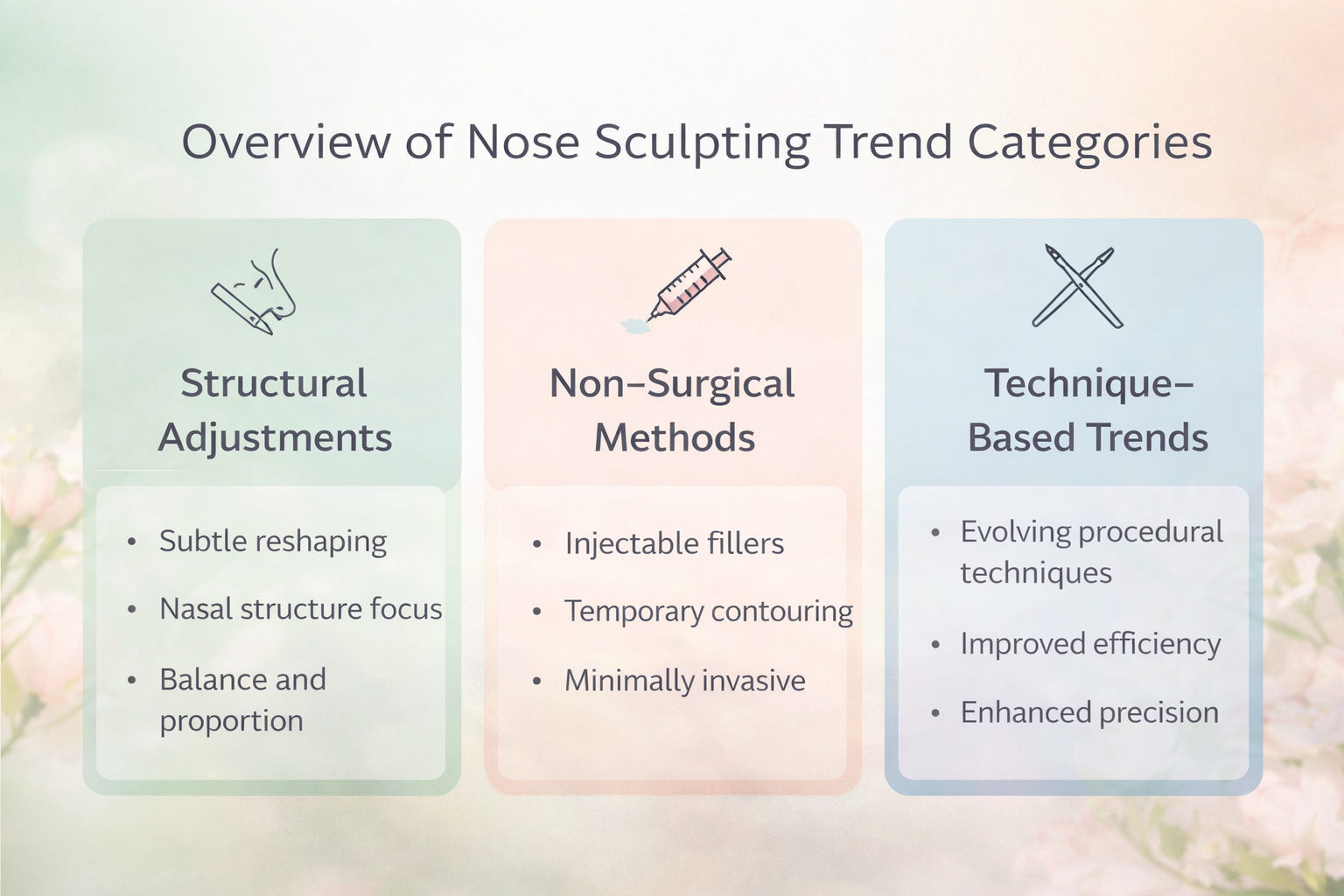
Visual summary of current nose sculpting trend categories
Disclaimer
This article is for general informational and educational purposes only. It does not constitute professional medical, surgical, diagnostic, or consumer purchasing advice. References to procedures, providers, or methods do not imply endorsement or guarantee of results. Readers are encouraged to consult licensed medical professionals and official resources before making any medical decision.